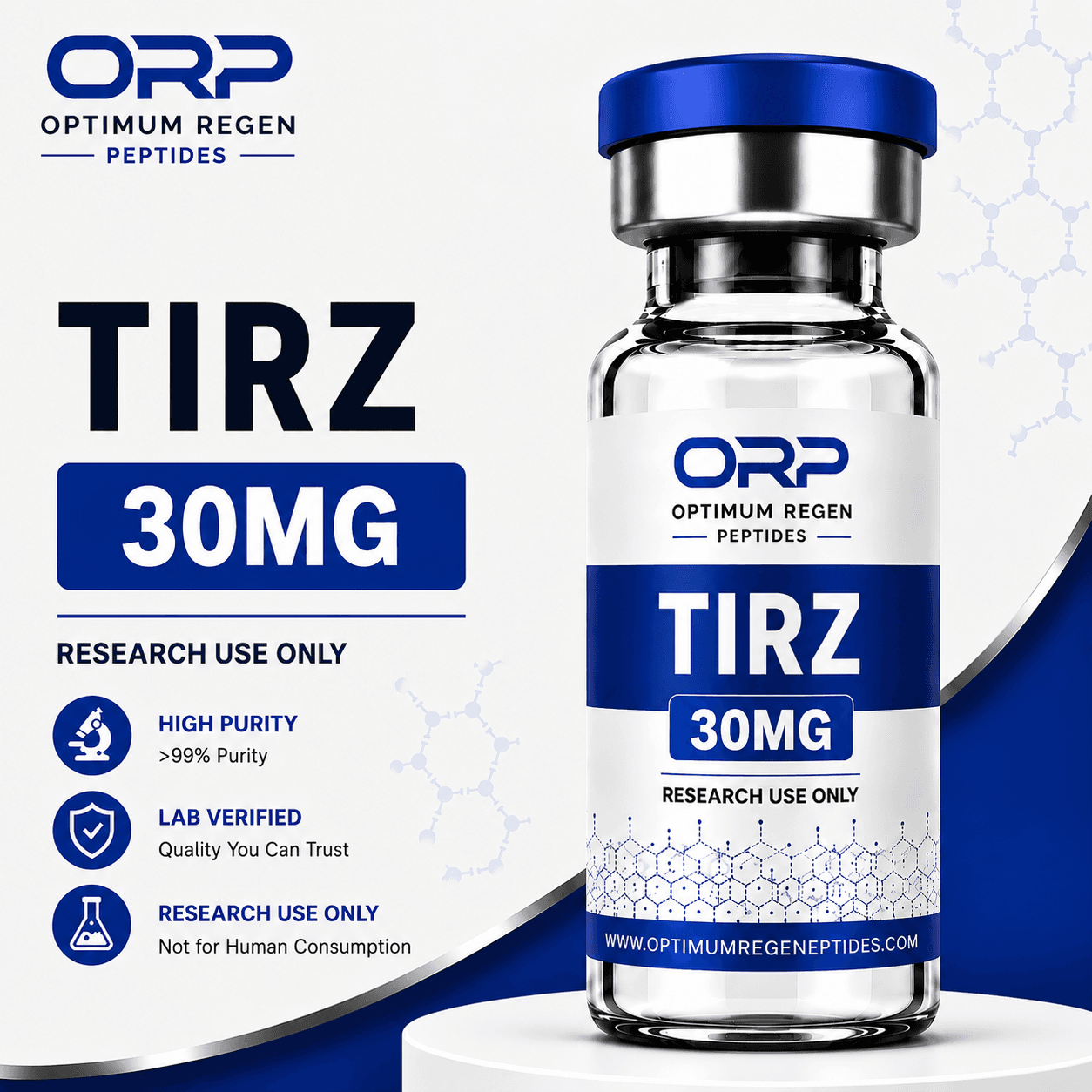
Tirz
Compounded in a licensed US 503A pharmacy 🇺🇸
Dual Pathway Research Peptide.
Tirz is a synthetic dual GIP (glucose-dependent insulinotropic polypeptide) and GLP-1 (glucagon-like peptide-1) receptor co-agonist studied in incretin biology and metabolic pathway research models. Laboratory researchers investigate its simultaneous engagement of GIP-R and GLP-1R, examining additive receptor signaling, beta-cell function, and energy expenditure regulation in in vitro and preclinical metabolic study systems. It is widely used as a tool compound to compare dual versus single incretin receptor pharmacology in the context of glucose homeostasis and lipid metabolism research. Supplied in precision-measured 30mg lyophilized format for controlled laboratory investigation only. Not for human or veterinary use.
- 30mg lyophilized powder
- Research-grade formulation
- Secure, sealed vial
- Research use only
Independently tested by Freedom Diagnostics using HPLC and mass spectrometry. The figure above is this batch's own measured result, not a target.
GLP TZ · 30mg · Clear Cap · reported 04/29/2026
- 2-day shipping nationwide, flat $13
- Plain, discreet packaging. No product names on the outside.
- Tracking emailed the moment your order ships.
About Tirz
Tirz is a synthetic 39-amino acid peptide that functions as a dual agonist at the glucagon-like peptide-1 receptor (GLP-1R) and the glucose-dependent insulinotropic polypeptide receptor (GIPR). It was developed by Eli Lilly and Company and received FDA approval in 2022 (Mounjaro) for type 2 diabetes and in 2023 (Zepbound) for chronic weight management. Its design incorporates a fatty diacid moiety via a linker at lysine-26 to enable albumin binding and extend the half-life to approximately five days, supporting once-weekly administration in clinical study protocols.
The dual incretin mechanism of tirz has attracted broad research interest because GIP and GLP-1 receptors are co-expressed in key metabolic tissues including pancreatic islets, adipose tissue, and the central nervous system. Preclinical and clinical research has investigated how simultaneous agonism of both receptors influences insulin secretion, glucagon suppression, gastric emptying, adipogenesis, and body weight regulation differently from selective GLP-1 receptor agonists.
As a research compound, tirz is studied to better understand the biology of the incretin system and the metabolic consequences of dual GIPR/GLP-1R engagement. It is provided for laboratory research use only and is not supplied for therapeutic administration outside of formally regulated clinical contexts.
Buy Tirz online
Tirz (Tirzepatide) is in stock and available to buy online from Optimum ReGen Peptides — a real American research-peptide company with a physical storefront in Medford, Oregon, not an anonymous overseas dropshipper. Priced from $150, every order ships within two business days, flat $13 nationwide, in plain discreet packaging with tracking.
As your Tirz supplier we back every batch with a third-party certificate of analysis and compound in a licensed US 503A pharmacy. Vials are supplied lyophilized at analytical purity for laboratory and research use only, not for human consumption.
Researched For
Tirz is used in GLP-1R and GIPR transfected cell lines to investigate how simultaneous dual receptor agonism differs from monoagonism in cAMP production, beta-arrestin recruitment, and receptor internalization profiles.
Research in islet and beta-cell models has examined how tirz influences glucose-stimulated insulin secretion, beta-cell proliferation markers, and glucotoxicity protection compared to selective GLP-1R agonists.
GIPR is highly expressed in adipose tissue. Studies have investigated how tirz influences adipocyte differentiation, lipolysis signaling, and lipid storage gene expression in fat cell models.
Both GLP-1R and GIPR are expressed in hypothalamic and brainstem nuclei. Research has explored how tirz affects neuronal activity, neuropeptide expression, and energy balance-related gene programs in CNS cell and animal models.
Head-to-head studies in preclinical models have compared tirz to sema and other GLP-1R selective agonists to characterize the added contribution of GIPR co-activation to metabolic outcomes and receptor-level signaling differences.
How It Is Studied
In cell-based assays, tirz is applied to GLP-1R- or GIPR-expressing cell lines at picomolar to nanomolar concentrations. Researchers measure cAMP accumulation using HTRF or ELISA-based assays, cell-surface receptor expression by flow cytometry, and downstream phosphorylation events by immunoblot to construct mechanistic pharmacology profiles.
Preclinical mouse and rat models of diet-induced obesity and type 2 diabetes have been used to study tirz's effects on fasting and postprandial glucose, HbA1c-equivalent endpoints, body weight, adiposity, and liver steatosis markers. These studies often include pair-feeding controls and receptor-selective agonist comparators to dissect GLP-1R versus GIPR contributions.
Pharmacokinetic studies characterize tirz's plasma half-life, albumin binding fraction, volume of distribution, and metabolite profile. Mass spectrometry-based methods are used to quantify intact tirz and its degradation products in plasma samples from preclinical models, informing dosing interval design for experimental protocols.
Specifications
| Form | Lyophilized powder |
|---|---|
| Purity | >= 99% (HPLC) |
| CAS Number | 2023788-19-2 |
| Molar Mass | Approx. 4813.5 Da |
Storage & Handling
Store lyophilized tirz at -20 C or below, protected from light and humidity. The lyophilized form is stable for extended periods under these conditions. Reconstitute in sterile saline or bacteriostatic water using aseptic technique. Store reconstituted solutions at 4 C for short-term use or aliquot and freeze at -80 C to minimize degradation. Avoid repeated freeze-thaw cycles, which can promote peptide aggregation and loss of activity. The fatty diacid-modified structure of tirz should be considered when selecting reconstitution buffers to ensure full solubilization. Maintain full chain-of-custody documentation per laboratory protocol.
Frequently Asked Questions
What makes tirz a 'dual agonist' compared to sema?+
What is the role of GIPR in metabolic research?+
How is tirz's half-life extended for weekly dosing research models?+
Is tirz sequence related to native GLP-1 or GIP?+
What preclinical models have been used to study tirz?+
Related research compounds