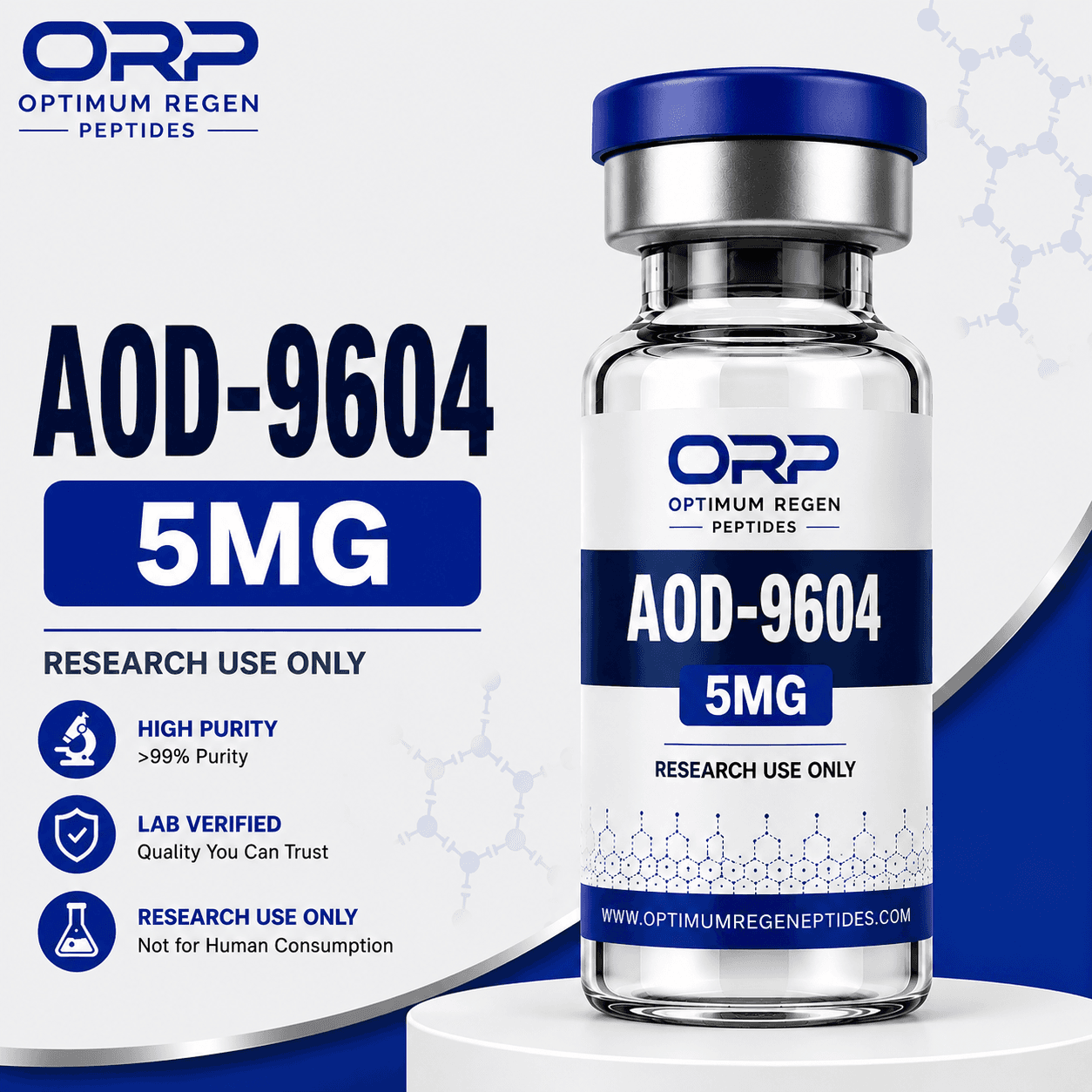
AOD-9604
Compounded in a licensed US 503A pharmacy 🇺🇸
AOD-9604 – Fragment 176-191 Metabolic Research Peptide.
AOD-9604 (Fragment 176-191) is a synthetic peptide derived from the C-terminal region of human growth hormone, investigated in lipolysis and lipid-metabolism research models. Researchers study this fragment for its selectivity within adipose tissue signaling pathways independent of IGF-1 receptor activation. It is commonly employed in in vitro fat-cell studies and preclinical metabolic investigations. Supplied as a precision-lyophilized peptide of high analytical purity for controlled laboratory use only. Reconstitute with bacteriostatic water under sterile conditions.
- Fragment 176-191 format
- Lyophilized research-grade powder
- Secure sealed vial
- Laboratory research only
Independently tested by Freedom Diagnostics using HPLC and mass spectrometry. The figure above is this batch's own measured result, not a target.
AOD-9604 · 5mg · Pink Cap · reported 08/11/2026
- 2-day shipping nationwide, flat $13
- Plain, discreet packaging. No product names on the outside.
- Tracking emailed the moment your order ships.
About AOD-9604
AOD-9604 is a synthetic peptide fragment derived from the C-terminus of human growth hormone (hGH), specifically corresponding to amino acids 177-191. Researchers originally investigated this fragment as part of efforts to isolate the lipolytic activity of hGH without the proliferative or metabolic side effects associated with the full molecule.
In laboratory settings, AOD-9604 has been studied for its interactions with beta-3 adrenergic receptors, which play a role in adipocyte metabolism. Preclinical models have examined how this fragment influences fat cell mobilization and lipogenesis without measurable impact on insulin-like growth factor-1 (IGF-1) levels, distinguishing it mechanistically from intact growth hormone.
Research into AOD-9604 has also explored its cartilage and bone metabolism properties in animal models. Studies published in peer-reviewed journals have investigated its potential utility in musculoskeletal research contexts, making it a compound of ongoing scientific interest across metabolic and regenerative biology disciplines.
Buy AOD-9604 online
AOD-9604 (HGH Fragment 176-191) is in stock and available to buy online from Optimum ReGen Peptides — a real American research-peptide company with a physical storefront in Medford, Oregon, not an anonymous overseas dropshipper. Priced from $50, every order ships within two business days, flat $13 nationwide, in plain discreet packaging with tracking.
As your AOD-9604 supplier we back every batch with a third-party certificate of analysis and compound in a licensed US 503A pharmacy. Vials are supplied lyophilized at analytical purity for laboratory and research use only, not for human consumption.
Researched For
AOD-9604 has been studied in vitro and in animal models for its influence on lipolytic pathways in fat cells, with researchers investigating how the peptide fragment interacts with adrenergic signaling to affect lipid mobilization.
Preclinical studies have examined AOD-9604 in the context of articular cartilage repair, with laboratory models investigating its effects on chondrocyte activity and extracellular matrix synthesis.
In vitro and animal-based studies have explored AOD-9604's interactions with osteoblast and osteoclast activity, investigating its role in bone remodeling pathways independent of IGF-1 signaling.
Researchers have studied how AOD-9604 interacts with beta-adrenergic receptors in metabolic models, examining its selectivity profile compared to native growth hormone fragments.
How It Is Studied
In laboratory research, AOD-9604 is typically administered to cell cultures or animal models and assessed using lipolysis assays, which measure free fatty acid release from adipocytes. Researchers employ radioimmunoassay and ELISA techniques to monitor downstream hormonal markers, confirming that the fragment does not stimulate IGF-1 production as full hGH does.
Cartilage research employing AOD-9604 often uses ex vivo tissue explants or primary chondrocyte cultures, with outcomes measured through histological staining (safranin-O, toluidine blue) and proteoglycan quantification. Researchers compare treated samples against controls to assess changes in cartilage matrix composition at the molecular level.
Metabolic studies use radiolabeled tracer techniques and indirect calorimetry in animal models to track shifts in substrate utilization when AOD-9604 is introduced. Gene expression panels targeting lipolytic enzymes (HSL, ATGL) are also used to profile the peptide's molecular activity at the transcriptional level.
Specifications
| Form | Lyophilized powder |
|---|---|
| Purity | >= 99% (HPLC) |
| Molecular Formula | C78H123N23O23S2 |
| Molar Mass | 1815.1 g/mol |
| CAS Number | 221231-10-3 |
| Sequence | Tyr-Leu-Arg-Ile-Val-Gln-Cys-Arg-Ser-Val-Glu-Gly-Ser-Cys-Gly-Phe (disulfide bridge) |
Storage & Handling
In lyophilized form, AOD-9604 research material should be stored at -20°C in a sealed container, protected from moisture and direct light. Under these conditions, the peptide maintains structural integrity for extended periods.
Once reconstituted for laboratory use, solutions should be kept at 4°C and used within 48 to 72 hours. Freeze-thaw cycles degrade the peptide and should be avoided; researchers typically prepare single-use aliquots prior to reconstitution.
Frequently Asked Questions
What distinguishes AOD-9604 from intact human growth hormone in research models?+
Has AOD-9604 been studied in cartilage research?+
What receptor pathways is AOD-9604 investigated for in metabolic research?+
How is AOD-9604 typically handled in a laboratory setting?+
Related research compounds