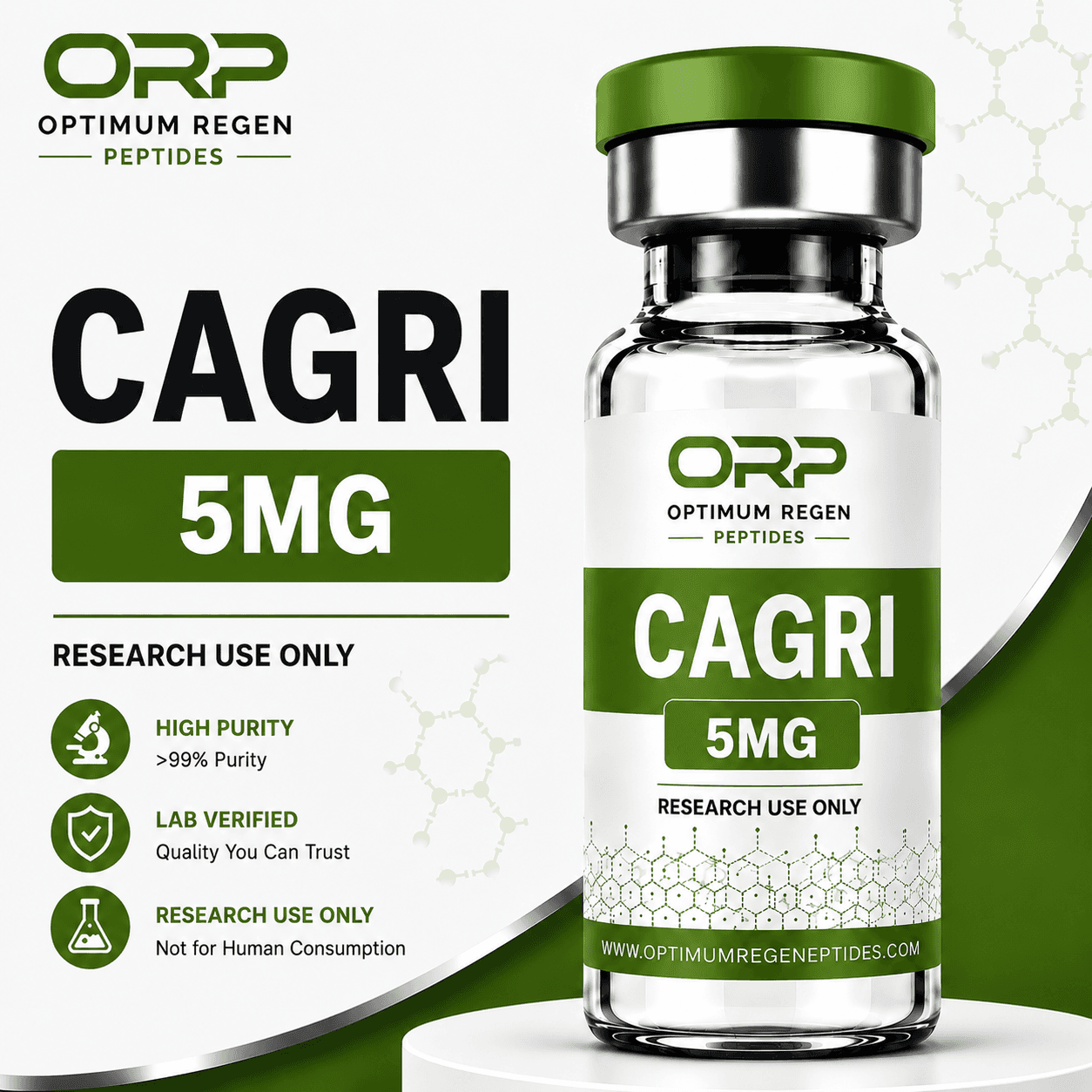
Cagri
Compounded in a licensed US 503A pharmacy 🇺🇸
Metabolic Research Peptide.
Cagri is a long-acting amylin analogue studied in metabolic and appetite-regulation research models, designed to mimic the satiety signaling of native amylin with an extended half-life. Preclinical researchers investigate its interactions with amylin receptors in the hypothalamus and its effects on energy intake and body weight homeostasis in cellular and animal models. It has been studied in combination with GLP-1 receptor agonists to assess additive effects on metabolic endpoints in laboratory settings. Supplied as a precision-lyophilized peptide for in vitro and preclinical research use only. Handle with standard peptide laboratory protocols.
- 5mg research vial
- Precision-measured formulation
- Stable lyophilized powder
- Research use only
Independently tested by Freedom Diagnostics using HPLC and mass spectrometry. We have not published a certificate for this product yet, so no purity figure is shown here. Every vial carries an accession number you can look up directly with the lab.
- 2-day shipping nationwide, flat $13
- Plain, discreet packaging. No product names on the outside.
- Tracking emailed the moment your order ships.
About Cagri
Cagri is a long-acting amylin analogue developed for investigation in metabolic research. Amylin is a pancreatic peptide co-secreted with insulin that plays roles in postprandial glucose regulation, gastric emptying, and satiety signaling. Cagri was engineered with fatty acid conjugation to extend its half-life relative to native amylin, making it suitable for once-weekly dosing regimens in clinical study contexts.
Research interest in cagri centers on its activity at amylin receptors (AMYR), calcitonin receptors, and CGRP receptor subtypes. Preclinical models have investigated its effects on food intake regulation, body weight trajectories, and glycemic parameters when administered alone or in combination with GLP-1 receptor agonists.
As a research compound, cagri is studied to better understand amylin receptor pharmacology and the additive or synergistic interactions possible when dual amylin/GLP-1 receptor pathways are engaged simultaneously. It is intended exclusively for laboratory research use and not for human or veterinary therapeutic application.
Buy Cagri online
Cagri (Cagrilintide) is in stock and available to buy online from Optimum ReGen Peptides — a real American research-peptide company with a physical storefront in Medford, Oregon, not an anonymous overseas dropshipper. Priced from $60, every order ships within two business days, flat $13 nationwide, in plain discreet packaging with tracking.
As your Cagri supplier we back every batch with a third-party certificate of analysis and compound in a licensed US 503A pharmacy. Vials are supplied lyophilized at analytical purity for laboratory and research use only, not for human consumption.
Researched For
Cagri is investigated as a tool to probe AMYR1-3 receptor biology and understand downstream signaling cascades in metabolic tissues.
Preclinical research has examined how sustained amylin receptor engagement influences circulating glucose, lipid profiles, and energy balance markers in animal models.
Amylin analogues have been studied for their effects on gastric emptying rate, a mechanism investigated in the context of postprandial glycemic excursion research.
Cagri has been co-administered with GLP-1 receptor agonists in research settings to investigate additive effects on body weight and metabolic endpoints compared to monotherapy.
Laboratory research has explored cagri's interaction with central nervous system pathways involved in appetite regulation, including hypothalamic and brainstem amylin receptor populations.
How It Is Studied
In preclinical models, cagri is typically administered subcutaneously at defined intervals to maintain sustained receptor occupancy, reflecting its long-acting pharmacokinetic profile. Researchers measure outcomes including food intake, body weight, fasting glucose, and insulin sensitivity across study durations.
Combination study designs pair cagri with sema or other GLP-1 receptor agonists to evaluate whether dual amylin/GLP-1 receptor engagement produces outcomes distinct from either mechanism alone. Such designs help researchers model the pharmacodynamics of multi-target metabolic interventions.
In vitro receptor binding assays and cAMP accumulation studies are used to characterize cagri's affinity and activity at AMYR subtypes relative to native amylin and other analogues, providing mechanistic context for the in vivo observations.
Specifications
| Form | Lyophilized powder |
|---|---|
| Purity | >= 99% (HPLC) |
| CAS Number | 2381272-26-8 |
| Molar Mass | Approx. 4296 Da (conjugated form) |
Storage & Handling
Store lyophilized cagri at -20 C or below, protected from light and moisture. Once reconstituted in an appropriate sterile diluent, aliquot and store at -80 C for longer-term stability or at 4 C for short-term use within the validated stability window documented in your laboratory protocol. Minimize freeze-thaw cycles. All storage and handling should comply with institutional biosafety and chemical hygiene guidelines.
Frequently Asked Questions
What is cagri's receptor selectivity profile?+
How does the fatty acid conjugation affect cagri's research properties?+
What models are used to study cagri in preclinical research?+
Has cagri been studied in combination with other compounds?+
What is the research status of cagri?+
Related research compounds