Up to 31% off peptides
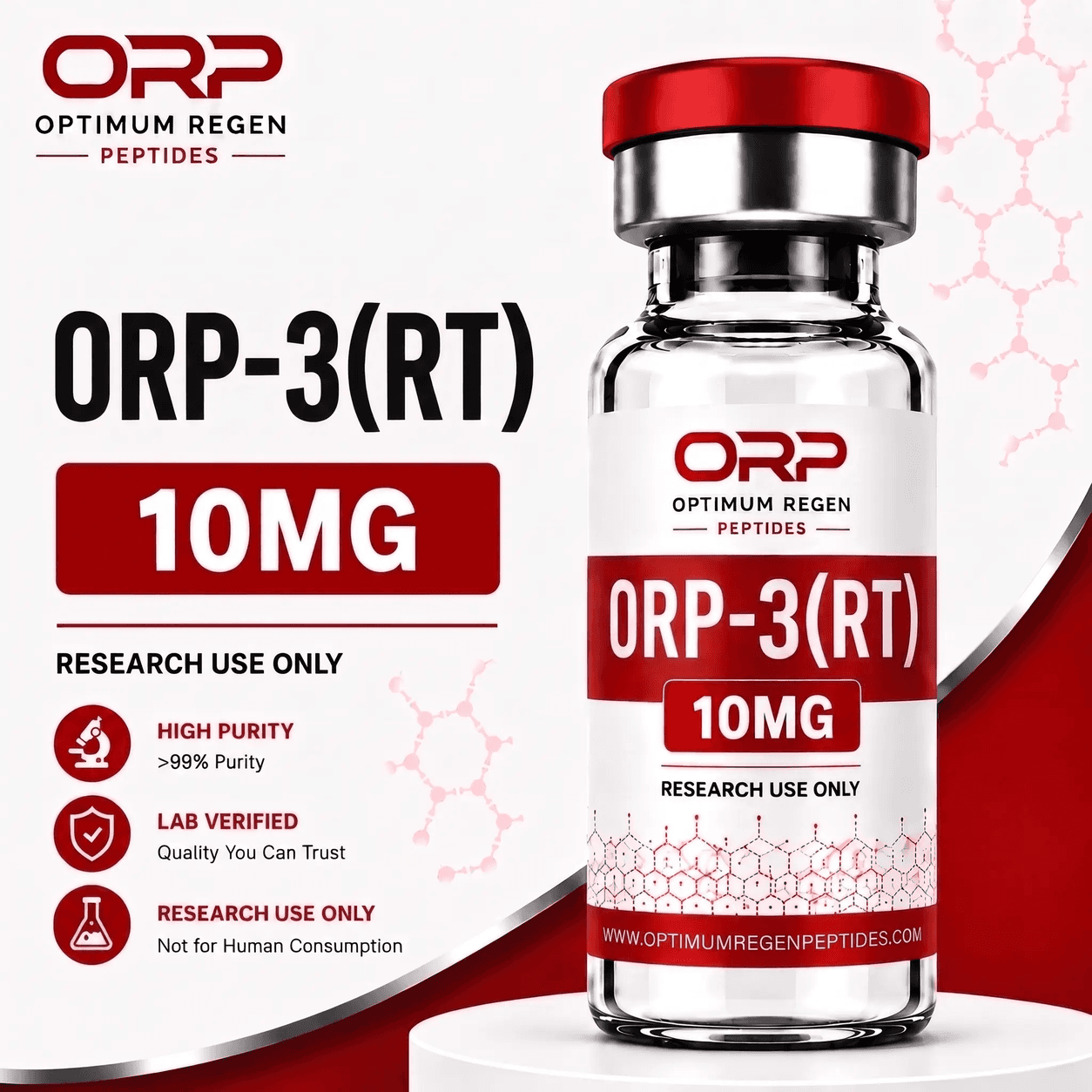
ORP-3(RT) 10mg research vial

ORP‑3(RT)

For laboratory research. Sold in 10mg, 30mg, 30mg x 2, 100mg and 300mg kit sizes.

$51.75
$7531% off
In stock2-Day Priority Air anywhere in the US
Choose your size
Savings per mg compared with the 10mg size.
1
Secure checkout2-Day Priority AirThird-party tested

Complete the order

Frequently bought together

Supplies and compounds researchers add to this order

Finding add-ons…
Shipping & returns
  • 2-Day Priority Air: $13 flat anywhere in the US, or pick up in Medford.
  • Tracking is emailed the moment your order ships.
  • Research compounds are final sale; see the refund policy.
Lab sheet

ORP-3(RT), measured

Identity, purity and handling data for this compound, in one place. Tap an identifier to copy it.

Certificate of analysis
99.84%
HPLC purity, 10mg lot, reported 04/29/2026
Tested by Freedom Diagnostics, an independent lab. Search code Opti2604280003
View the certificate
Form
Lyophilized powder
Full data sheet+
Purity
See the available batch report for the tested sample's purity. Confirm the product and lot before ordering.
Storage
Store at -20 °C, lyophilized; protect from light and humidity

For research use only. Not for human consumption.

Overview

About ORP-3(RT)

ORP-3(RT) is a synthetic peptide developed for laboratory research as a triple receptor agonist, meaning a single molecule engineered to bind and activate three distinct receptor targets rather than one. It is investigated in research models for activity at the glucagon-like peptide-1 receptor (GLP-1R), the glucose-dependent insulinotropic polypeptide receptor (GIPR), and the glucagon receptor (GCGR). Because all three receptors belong to the same proglucagon-derived peptide family, ORP-3(RT) is used by researchers to study how a single compound behaves across multiple related signaling pathways in one experimental system. It is supplied strictly for laboratory research use, not for human or animal consumption.

Read more

Research interest in ORP-3(RT) centers on its multi-receptor pharmacology. Each of the three receptors it engages, GLP-1R, GIPR, and GCGR, is a class B G protein-coupled receptor that signals primarily through adenylate cyclase and cyclic AMP production when activated. Laboratory studies on ORP-3(RT) examine receptor binding affinity, activation kinetics, and downstream second-messenger signaling at each receptor individually, as well as how simultaneous engagement of all three may alter the overall signaling profile compared to single-receptor activation.

As a triple receptor agonist, ORP-3(RT) is studied alongside single- and dual-receptor peptide analogs to characterize structure-activity relationships across the incretin and glucagon receptor family. Comparative in-vitro assays assess relative potency and selectivity at each receptor, while receptor internalization and desensitization studies explore how prolonged or repeated exposure affects receptor availability in cell-based systems. This research framework positions ORP-3(RT) as a reference compound for investigating multi-receptor agonism as a pharmacological strategy, distinct from mono-agonist peptides that target only one of these three receptors.

Because the GLP-1, GIP, and glucagon receptors are each implicated in distinct aspects of energy balance and glucose-regulatory signaling, ORP-3(RT) is used in preclinical and in-vitro research to map how combined activation of these pathways is coordinated at the cellular level. Studies in this area typically rely on isolated cell lines expressing one or more of the target receptors, as well as rodent models used to characterize receptor pharmacology and signaling cascades. This research is exploratory and mechanistic in nature, intended to inform the broader scientific understanding of multi-receptor incretin and glucagon-family biology.

ORP-3(RT) is distributed by Optimum ReGen Peptides for laboratory research. Review available batch reports and contact us for documentation on the specific product and lot before ordering.

ORP-3(RT) is supplied as a lyophilized, freeze-dried powder intended for reconstitution in a laboratory setting prior to use in cell-based or preclinical experimental protocols. Researchers should follow the storage and handling guidance provided with each shipment and accompanying certificate of analysis to preserve peptide stability between receipt and use.

ORP-3(RT) is sold exclusively for laboratory research use by qualified professionals and institutions. It is not approved, and not intended, for human or animal consumption, and no health or disease-related claims are made about it. This listing is provided for research and informational purposes only and does not constitute medical advice.

Research context

What ORP-3(RT) is researched for

The areas where this compound appears in the published research literature.

0105 areas

Triple-receptor agonism

Comparative study of simultaneous GLP-1, GIP, and glucagon receptor engagement.

0205 areas

Metabolic signaling research

Mapping second-messenger cascades downstream of incretin and glucagon pathways.

0305 areas

Energy-balance models

Preclinical investigation of energy expenditure and substrate-handling endpoints.

0405 areas

Receptor selectivity studies

Characterizing binding affinity and signaling bias across the proglucagon family.

0505 areas

Comparative pharmacology

Benchmarking against GLP-1 and GLP-1/GIP comparators in research assays.

Methodology

How ORP-3(RT) is studied

  1. 01Method 1In laboratory research, incretin and glucagon receptor peptides are typically studied using heterologous expression systems in which the relevant receptor is…+

    In laboratory research, incretin and glucagon receptor peptides are typically studied using heterologous expression systems in which the relevant receptor is expressed in cell lines (e.g., HEK293 or CHO cells), and peptide binding and receptor activation are assessed via cAMP accumulation assays, radioligand binding, or BRET-based biosensors.

  2. 02Method 2Preclinical metabolic studies use rodent models of glucose challenge or metabolic perturbation to assess effects on insulin secretion, energy expenditure, and substrate handling.+

    Preclinical metabolic studies use rodent models of glucose challenge or metabolic perturbation to assess effects on insulin secretion, energy expenditure, and substrate handling. ORP-3(RT) is of particular interest as a tool for comparing triple-pathway activity against single- and dual-agonist reference compounds.

Storage protocols

ORP-3(RT) storage and handling

Lyophilized
-20°C
Long-term storage, as supplied
Full handling protocol+

Lyophilized research-grade peptides should be stored at -20 °C in a desiccated, sealed environment away from direct light. Reconstituted solutions should be prepared fresh in sterile aqueous buffer appropriate for the assay system and used promptly or stored at -80 °C in single-use aliquots.

Peptide stability in solution is influenced by pH, temperature, and solvent composition. Researchers should consult peptide-specific stability data and use the minimum number of freeze-thaw cycles to preserve structural integrity and biological activity in experimental preparations.

Ordering & shipping

Buy ORP-3(RT) online

ORP-3(RT) for sale from Optimum ReGen Peptides, a US research-peptide company with a storefront in Medford, Oregon. It is in stock, priced from $75. Every order ships 2-Day Priority Air, a $13 flat rate anywhere in the US, with tracking, or can be picked up at the store.

The current batch has a published third-party certificate of analysis, shown above. ORP-3(RT) is supplied as lyophilized powder, for laboratory and research use only, not for human consumption.
FAQ

ORP-3(RT) FAQ

What is ORP-3(RT)?
ORP-3(RT) is a synthetic triple receptor agonist peptide investigated in laboratory research for activity at the GLP-1, GIP, and glucagon receptors. It is supplied as a lyophilized powder for laboratory research use only and is not intended for human or animal consumption.
What is GLP-3R used for in research?
GLP-3R is a common search term for ORP-3(RT), a peptide studied in preclinical and in-vitro models to characterize simultaneous engagement of the GLP-1, GIP, and glucagon receptor pathways. Researchers use it to compare signaling behavior against single- and dual-receptor peptide analogs within the proglucagon-derived peptide family.
What is a triple receptor agonist?
A triple receptor agonist is a single molecule capable of binding and activating three distinct receptor targets instead of one. In ORP-3(RT) research, this means investigating concurrent activity at the GLP-1, GIP, and glucagon receptors within the same experimental system.
How does ORP-3(RT) interact with the GLP-1, GIP, and glucagon receptors?
Research on ORP-3(RT) examines binding affinity, receptor activation kinetics, and downstream second-messenger signaling, such as cyclic AMP production, at each of the three receptors individually and in combination. Comparative studies assess whether engaging all three pathways together produces a different signaling profile than activating any single receptor alone.
Is ORP-3(RT) the same peptide researchers search for as GLP-3R?
Yes. GLP-3R is a shorthand term some researchers use when searching for this compound, which is manufactured and sold under the product name ORP-3(RT).
Is ORP-3(RT) third-party tested?
Published reports are available for specific ORP-3(RT) samples. Check each report against the product and lot you are considering; it does not establish that every batch has been tested. Contact ORP for additional documentation.
How is ORP-3(RT) supplied and stored?
ORP-3(RT) is supplied as a lyophilized, freeze-dried powder intended for reconstitution in a laboratory setting prior to research use. Storage and handling guidance is provided with each shipment and the accompanying certificate of analysis to help preserve peptide stability.
Is ORP-3(RT) approved for human or animal use?
No. ORP-3(RT) is manufactured and sold strictly for laboratory research use by qualified professionals. It is not approved, and not intended, for human or animal consumption, and no health claims are made about it.
What research models is ORP-3(RT) studied in?
Triple-receptor peptides of this class are typically studied using isolated cell-based receptor assays and preclinical rodent models to characterize receptor engagement and signaling. ORP-3(RT) is supplied to support this type of in-vitro and preclinical experimental work.
How does ORP-3(RT) compare to single-receptor incretin agonists in research?
Because ORP-3(RT) engages the GLP-1, GIP, and glucagon receptors within one molecule, researchers can use it to study combined multi-receptor signaling patterns rather than the isolated single-receptor activity captured by mono-agonist peptides. This positions it as a reference compound in comparative structure-activity and receptor-selectivity research.
Where can I find batch documentation for ORP-3(RT)?
Review the available batch reports for ORP-3(RT), or contact us for documentation on a specific lot.
What analytical methods verify ORP-3(RT)'s identity and purity?
Read the methods and results on the available report for the specific sample. Analytical techniques such as HPLC and mass spectrometry can assess purity and identity, but the report must be matched to the product and lot under consideration.
Research library

ORP-3(RT) research guides

Optimum ReGen Peptides

Optimum ReGen Peptides provides high-quality peptide compounds for laboratory research applications. All research products, including all peptides, are strictly for research purposes only and are not intended for human consumption.

Research products are intended for laboratory research purposes only. Not for human consumption. Our tallow skincare products are topical cosmetics for external use only. No product is intended to diagnose, treat, cure, or prevent any disease.

Get new drops & restocks

New compounds, restock alerts, and updates from a real US lab. Research use only.

Payment options are checked at checkout

© 2026 Optimum ReGen Peptides. All rights reserved.
Engineered for Consistency. Built for Research.