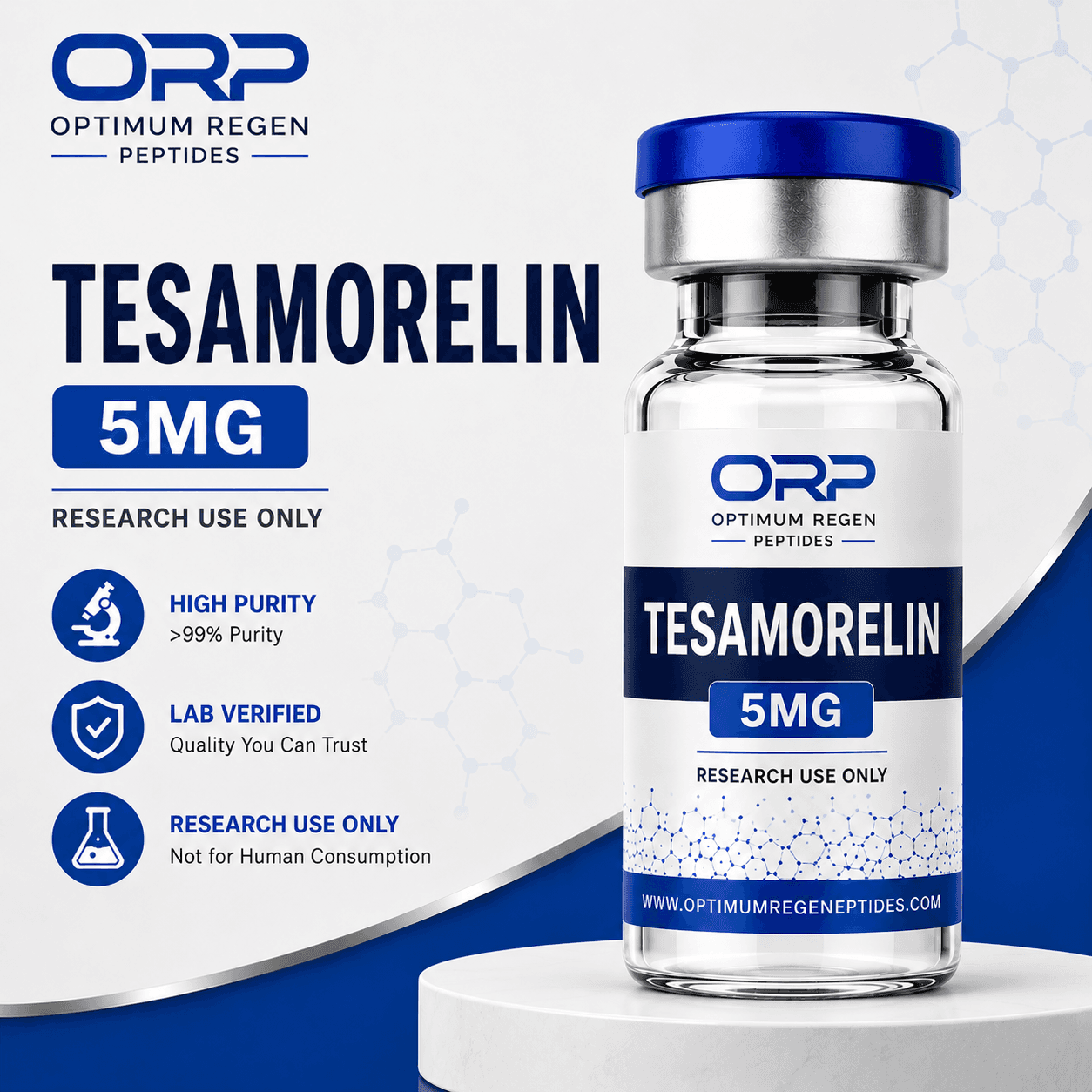
Tesamorelin
Compounded in a licensed US 503A pharmacy 🇺🇸
Growth Hormone Releasing Research Peptide.
Tesamorelin is a stabilized synthetic analogue of growth hormone-releasing hormone (GHRH) with a trans-3-hexenoic acid modification at the N-terminus for improved plasma stability, studied in somatotropic axis research. Preclinical researchers investigate its interactions with pituitary GHRH receptors, pulsatile GH secretion dynamics, and downstream IGF-1 axis regulation in in vitro and animal model systems. It is also studied in visceral adipose tissue metabolism research in preclinical settings, where GHRH receptor activation and lipid mobilization pathways are examined. Supplied as a lyophilized peptide of analytical purity for laboratory research use only. For in vitro and preclinical investigation; not for human use.
- 5mg lyophilized format
- Precision measured
- Stored under sterile conditions
- Research use only
Independently tested by Freedom Diagnostics using HPLC and mass spectrometry. The figure above is this batch's own measured result, not a target.
Tesamorelin · 10mg · White Cap · reported 03/27/2026
- 2-day shipping nationwide, flat $13
- Plain, discreet packaging. No product names on the outside.
- Tracking emailed the moment your order ships.
About Tesamorelin
Tesamorelin is a 44-amino-acid synthetic peptide classified as a growth hormone-releasing hormone (GHRH) analogue. Structurally, it corresponds to the biologically active 1-44 fragment of human GHRH, with a trans-3-hexenoic acid group conjugated to the N-terminus. This modification is the defining feature that separates tesamorelin from native GHRH in laboratory characterization work, and it is the reason researchers select tesamorelin specifically when a longer plasma observation window is needed for pituitary-axis experiments.
As a GHRH analogue, tesamorelin is studied for its interaction with the GHRH receptor (GHRH-R) expressed on anterior pituitary somatotroph cells. Receptor binding activates a Gs-protein-coupled cascade that raises intracellular cAMP, a signaling step researchers track when characterizing growth hormone (GH) synthesis and pulsatile release in vitro and in animal models. Because tesamorelin retains full agonist activity at GHRH-R while resisting the enzymatic cleavage that limits native GHRH, it has become a standard reference compound in GHRH analogue research on receptor selectivity, signal transduction, and comparative pharmacokinetics.
The trans-3-hexenoic acid modification protects tesamorelin from dipeptidyl peptidase IV (DPP-IV), the enzyme primarily responsible for the rapid plasma clearance of unmodified GHRH. Plasma incubation studies paired with LC-MS/MS quantification are the standard methodology researchers use to characterize this resistance, comparing degradation curves of tesamorelin against native GHRH and against other GHRH-axis analogues such as sermorelin and CJC-1295. This comparative stability profile is a recurring reference point in peptide-axis literature and a key reason tesamorelin research peptide protocols favor it for extended time-course sampling.
Beyond receptor pharmacology, tesamorelin research peptide protocols extend into GH/IGF-1 axis regulation, visceral adipose tissue biology, hepatic lipid metabolism, and, in more exploratory work, hippocampal and cognitive-marker studies. Rodent and in vitro models are used to examine how sustained GHRH receptor stimulation feeds forward into IGF-1 production, adipocyte gene expression, and lipoprotein profiles.
Tesamorelin reconstitution in a laboratory setting follows standard peptide-handling protocol: the lyophilized powder is brought to room temperature, then a sterile diluent such as bacteriostatic water is added slowly down the vial wall and mixed by gentle swirling rather than shaking, which can disrupt the peptide's secondary structure. Reconstituted stock solutions are typically prepared to a defined mg/mL concentration for aliquoting into assay volumes, kept refrigerated at 4 degrees C, and used within 24 hours since the product contains no preservative. Unreconstituted, lyophilized tesamorelin should be stored at -20 degrees C, sealed and protected from light, to preserve peptide integrity for longer-term laboratory inventory.
Researchers who buy tesamorelin research peptide from Optimum ReGen Peptides receive product compounded by a licensed US 503A pharmacy, with each production batch verified at 99% or greater purity by third-party HPLC testing and a corresponding certificate of analysis available per lot. Tesamorelin for sale on this page is listed in multiple lyophilized quantities to support laboratories scaling from single-vial pilot work up to larger multi-kit study designs, with COAs, purity data, and cold-chain shipping handled from dispatch to delivery. Every tesamorelin peptide buy order placed through this site is limited to qualified research use and processed accordingly.
This tesamorelin listing is intended strictly for laboratory and in vitro research by qualified professionals and institutions. It is not for human consumption, not for veterinary use, and is not intended to diagnose, treat, cure, or prevent any disease. No content on this page constitutes medical advice or guidance for human administration; all handling described here refers to laboratory research protocol only.
Buy Tesamorelin online
Tesamorelin is in stock and available to buy online from Optimum ReGen Peptides — a real American research-peptide company with a physical storefront in Medford, Oregon, not an anonymous overseas dropshipper. Priced from $50, every order ships within two business days, flat $13 nationwide, in plain discreet packaging with tracking.
As your Tesamorelin supplier we back every batch with a third-party certificate of analysis and compound in a licensed US 503A pharmacy. Vials are supplied lyophilized at analytical purity for laboratory and research use only, not for human consumption.
Researched For
Tesamorelin is used as a GHRH analog in studies examining pituitary somatotroph function, GH pulse amplitude and frequency analysis, and downstream IGF-1 and IGFBP-3 production in preclinical and study-population samples.
Research has examined Tesamorelin's effects on visceral fat depots in both animal models and study populations, characterizing changes in adipocyte lipid turnover markers, adipokine profiles, and imaging-quantified fat volume.
Researchers have studied Tesamorelin in the context of dyslipidemia-associated research, examining changes in triglyceride levels, lipoprotein profiles, and hepatic lipid accumulation markers as downstream endpoints of GH axis stimulation.
Given GH/IGF-1 axis involvement in neural tissue maintenance, researchers have investigated Tesamorelin in models examining hippocampal neurogenesis markers, cognitive performance endpoints, and amyloid-related pathway markers in aging animal models.
Laboratory and study-based research has used Tesamorelin to examine how GH axis stimulation interacts with insulin sensitivity markers, glucose homeostasis endpoints, and adipose tissue inflammatory gene expression patterns.
How It Is Studied
In preclinical studies, Tesamorelin is administered by subcutaneous injection to rodent models, with blood sampling at defined intervals to construct GH pulse profiles using ultrasensitive immunoassays. IGF-1 and IGFBP-3 serum levels are quantified by ELISA as downstream markers of somatotroph axis stimulation. Adipose tissue is harvested for gene expression profiling using RT-PCR panels targeting lipogenic and lipolytic enzyme genes.
Researchers characterize Tesamorelin's DPP-IV resistance by incubating the compound in plasma preparations and comparing intact peptide recovery over time against unmodified GHRH using LC-MS/MS. This confirms that the N-terminal modification confers the intended enzymatic stability and validates the pharmacokinetic rationale for the structural design.
In metabolic research designs, indirect calorimetry, body composition analysis by DEXA or MRI, and comprehensive metabolic panel measurement are used as systemic endpoint readouts in animal model studies. Researchers also examine pituitary somatotroph density and GH granule content by electron microscopy in long-term treatment cohorts to assess gland-level response to chronic GHRH receptor stimulation.
Specifications
| Form | Lyophilized powder |
|---|---|
| Purity | >= 99% (HPLC) |
| Chain length | 44 amino acids (GHRH analog) |
| N-terminal modification | trans-3-hexenoic acid conjugate |
| Storage (lyophilized) | -20 °C, sealed, light-protected |
| Storage (reconstituted) | 4 °C, use within 24 hours (no preservative) |
Storage & Handling
Lyophilized Tesamorelin should be stored at -20 °C, protected from light and humidity, in sealed vials. The lyophilized form is stable for extended periods under these conditions. For reconstitution, sterile water for injection or the provided diluent is used; the reconstituted solution should be used promptly, ideally within 24 hours when no preservative is present, or within the timeframe specified by the study protocol.
Tesamorelin solutions should not be vigorously shaken, as mechanical agitation can disrupt protein structure. Gentle swirling is the recommended mixing method. Any unused reconstituted solution should be discarded at the end of the working day. Pre-aliquoting the lyophilized powder into single-experiment portions before any reconstitution minimizes waste and cycle-related degradation.
Frequently Asked Questions
What is tesamorelin?+
What is a GHRH analogue used for in research?+
Is tesamorelin a research peptide?+
Where can I buy tesamorelin research peptide?+
How do you reconstitute tesamorelin for research use?+
What is the purity of tesamorelin sold at Optimum ReGen Peptides?+
How is tesamorelin different from sermorelin or CJC-1295 in research?+
How should tesamorelin be stored before reconstitution?+
Does tesamorelin require a prescription to purchase for research?+
What does tesamorelin do in GHRH receptor studies?+
Is tesamorelin FDA approved?+
Related research compounds