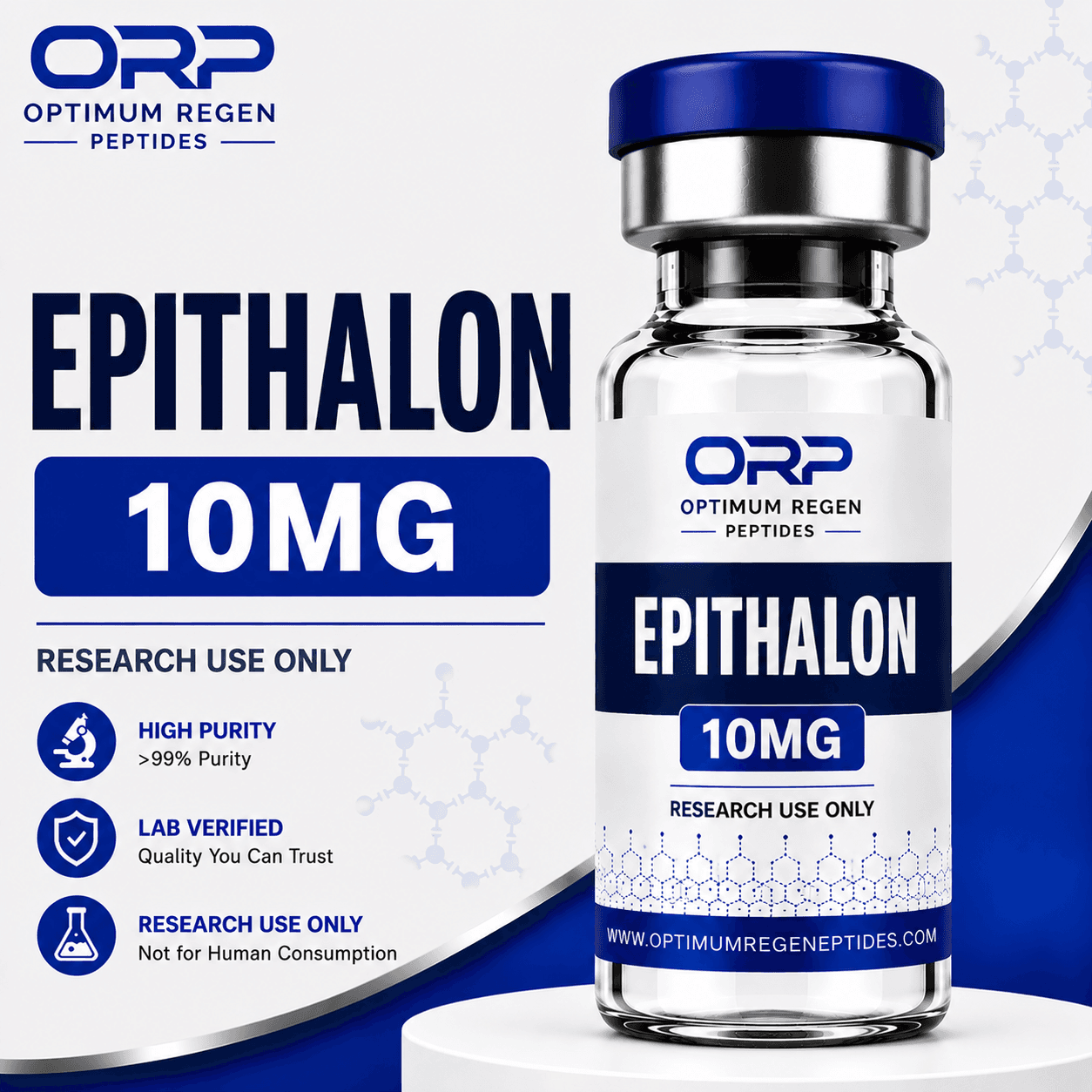
Epithalon
Compounded in a licensed US 503A pharmacy 🇺🇸
Longevity Research Peptide.
Epithalon (Epitalon) is a synthetic tetrapeptide (Ala-Glu-Asp-Gly) derived from the pineal gland extract Epithalamin, studied extensively in cellular aging, telomerase activity, and circadian regulation research. Laboratory scientists investigate its effects on telomere length dynamics and the activation of telomerase reverse transcriptase (hTERT) in cultured human cell lines. It is also examined in the context of melatonin synthesis pathways and neuroendocrine signaling in preclinical model systems. Supplied as a stable lyophilized peptide of analytical purity for in vitro and preclinical research use only. Handle under sterile laboratory conditions.
- 10mg research vial
- Research-grade formulation
- Stable lyophilized powder
- Laboratory research only
Independently tested by Freedom Diagnostics using HPLC and mass spectrometry. We have not published a certificate for this product yet, so no purity figure is shown here. Every vial carries an accession number you can look up directly with the lab.
- 2-day shipping nationwide, flat $13
- Plain, discreet packaging. No product names on the outside.
- Tracking emailed the moment your order ships.
About Epithalon
Epithalon (also spelled Epitalon) is a synthetic tetrapeptide with the sequence Ala-Glu-Asp-Gly. It was originally identified by the research group of Vladimir Khavinson at the St. Petersburg Institute of Bioregulation and Gerontology as a synthetic analog of epithalamin, a polypeptide extract derived from the pineal gland. Epithalon has become a subject of laboratory research focused on telomere biology and circadian regulatory mechanisms.
The compound has been studied in cell culture systems and rodent models for its reported interactions with telomerase enzyme activity. Researchers have examined whether Epithalon exposure influences telomere length maintenance in aging cell populations, placing it within the broader field of molecular gerontology research. These studies are conducted under controlled laboratory conditions and remain at the preclinical stage.
Epithalon is also investigated for its relationship with melatonin secretion and the hypothalamic-pineal axis in aging animal models. Laboratory studies have characterized changes in circadian hormone profiles and antioxidant enzyme expression following Epithalon treatment in aged rodent cohorts. All research use of this compound is confined to scientifically supervised laboratory settings.
Buy Epithalon online
Epithalon (Epitalon) is in stock and available to buy online from Optimum ReGen Peptides — a real American research-peptide company with a physical storefront in Medford, Oregon, not an anonymous overseas dropshipper. Priced from $40, every order ships within two business days, flat $13 nationwide, in plain discreet packaging with tracking.
As your Epithalon supplier we back every batch with a third-party certificate of analysis and compound in a licensed US 503A pharmacy. Vials are supplied lyophilized at analytical purity for laboratory and research use only, not for human consumption.
Researched For
Epithalon has been studied in human cell lines and rodent models for its reported capacity to influence telomerase activity, making it a tool compound in aging biology research focused on chromosomal end-cap maintenance.
As a synthetic analog of a pineal peptide extract, Epithalon has been used in laboratory investigations examining melatonin secretion patterns and age-related decline in pineal function in animal models.
Studies in aged rodents have examined Epithalon's relationship with superoxide dismutase, catalase, and glutathione peroxidase expression as markers of oxidative stress regulation at the cellular level.
Laboratory investigations have used Epithalon to study interactions with the hypothalamic-pituitary axis in aging models, examining hormonal profiles including gonadotropin and cortisol patterns in treated versus control animals.
Preclinical oncology research has examined Epithalon in chemically induced and spontaneous tumor models in rodents, studying proliferation markers, apoptosis indices, and tumor incidence endpoints in geroprotection frameworks.
How It Is Studied
Epithalon is studied in aging rodent models via intraperitoneal or subcutaneous administration, with researchers examining longitudinal biomarkers across treatment cohorts. Telomerase activity is quantified using TRAP (telomeric repeat amplification protocol) assays in harvested tissue samples. Melatonin and hormone levels are assessed from blood samples by radioimmunoassay or ELISA.
In cell culture research, Epithalon is applied to human somatic cell lines undergoing replicative senescence. Researchers measure telomere length by Southern blotting or quantitative PCR, and assess telomerase expression by RT-PCR and Western blot. Senescence-associated beta-galactosidase staining and Ki-67 proliferation indexing are used as complementary readouts.
Researchers also examine Epithalon in the context of antioxidant enzyme assays in liver and brain tissue homogenates from aged animals. Spectrophotometric enzyme activity assays and oxidized-protein quantification (DNPH-based carbonyl assays) are standard methods used to characterize oxidative stress parameters in experimental cohorts.
Specifications
| Form | Lyophilized powder |
|---|---|
| Purity | >= 99% (HPLC) |
| Sequence | Ala-Glu-Asp-Gly (AEDG) |
| Molecular Formula | C14H22N4O9 |
| Molar Mass | 390.35 g/mol |
| CAS Number | 307297-39-8 |
Storage & Handling
Lyophilized Epithalon is stable at -20 °C for extended periods when stored in a sealed, desiccated container protected from light and humidity. The tetrapeptide structure is relatively robust in powder form. Upon reconstitution in sterile water or saline, the solution should be kept at 4 °C and used within 5 to 7 days.
For research workflows requiring multiple experiments, preparation of single-use aliquots before reconstitution is advised to prevent degradation from repeated thawing. Researchers should document reconstitution date, vehicle used, and final concentration on each labeled aliquot.
Frequently Asked Questions
What is the origin of Epithalon in research?+
How does Epithalon relate to telomerase research?+
Is Epithalon the same as epithalamin?+
What cell types are most commonly used to study Epithalon in vitro?+
Is Epithalon approved for any clinical application?+
Related research compounds