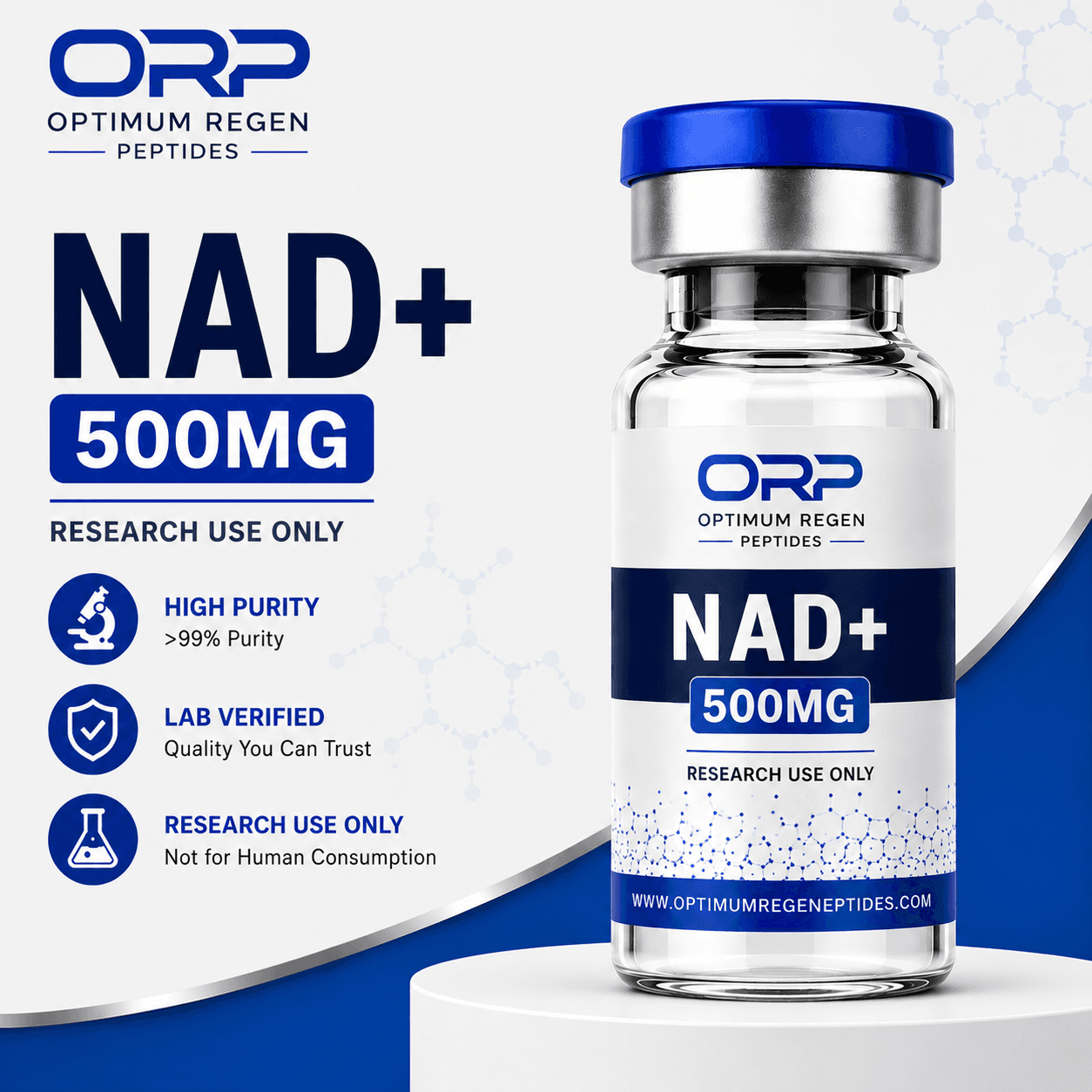
NAD+
Compounded in a licensed US 503A pharmacy 🇺🇸
High-Dose Research Format.
NAD+ (Nicotinamide Adenine Dinucleotide) is a critical coenzyme present in all living cells, studied in cellular energy metabolism, DNA repair, and sirtuin-pathway research. Laboratory researchers investigate its role as a substrate for PARP enzymes, CD38, and the sirtuin family of NAD-dependent deacylases in the context of mitochondrial biogenesis and aging-related signaling. Supplied at 500mg of analytical-purity NAD+ in lyophilized format, designed to support extended or high-volume laboratory research protocols. For in vitro and preclinical research use only. Handle under controlled conditions; store protected from light and humidity.
- 500mg format
- High purity compound
- Secure storage vial
- Not for human consumption
Independently tested by Freedom Diagnostics using HPLC and mass spectrometry. The figure above is this batch's own measured result, not a target.
NAD+ · Blue Cap · reported 03/27/2026
- 2-day shipping nationwide, flat $13
- Plain, discreet packaging. No product names on the outside.
- Tracking emailed the moment your order ships.
About NAD+
NAD+ 500 (nicotinamide adenine dinucleotide, 500 mg formulation) provides research-grade NAD+ for laboratory investigation of cellular energy metabolism, mitochondrial function, and the diverse enzymatic reactions in which NAD+ serves as a critical coenzyme. NAD+ is a fundamental molecule in cellular biochemistry, functioning both as a hydride carrier in oxidation-reduction reactions and as a substrate for enzymes including sirtuins, PARPs, and CD38.
Research interest in NAD+ has grown substantially with the recognition that NAD+ levels decline with age in many tissue models and that restoring NAD+ availability influences a range of cellular processes including mitochondrial biogenesis, DNA repair, and inflammatory signaling. Laboratory studies use NAD+ preparations to investigate these pathways in cell culture and preclinical models.
Research-grade NAD+ 500 is utilized as a direct substrate in enzymatic assays, as a supplementation agent in cell culture experiments studying metabolic rescue, and in biochemical studies examining NAD+/NADH ratios and their relationship to cellular redox state and signaling.
Buy NAD+ online
NAD+ (Nicotinamide Adenine Dinucleotide) is in stock and available to buy online from Optimum ReGen Peptides — a real American research-peptide company with a physical storefront in Medford, Oregon, not an anonymous overseas dropshipper. Priced from $70, every order ships within two business days, flat $13 nationwide, in plain discreet packaging with tracking.
As your NAD+ supplier we back every batch with a third-party certificate of analysis and compound in a licensed US 503A pharmacy. Vials are supplied lyophilized at analytical purity for laboratory and research use only, not for human consumption.
Researched For
NAD+ is a central coenzyme in glycolysis, the citric acid cycle, and oxidative phosphorylation; laboratory research examines how NAD+ availability influences mitochondrial respiration rates and ATP production efficiency in cell culture models.
Sirtuins are NAD+-dependent deacylases implicated in aging biology and metabolic regulation; research uses NAD+ supplementation to investigate how sirtuin activity responds to changes in NAD+ availability in preclinical models.
PARP enzymes, which require NAD+ as a substrate, play critical roles in DNA damage repair; laboratory studies investigate the relationship between cellular NAD+ levels and the efficiency of PARP-mediated repair responses.
Researchers use NAD+ supplementation in preclinical models to examine its effects on mitochondrial number, membrane potential, and function, contributing to our understanding of mitochondrial health and biogenesis signaling.
Cell-based and animal studies have compared direct NAD+ supplementation with NAD+ precursors (NMN, NR) to characterize differences in cellular uptake, metabolic conversion, and resulting changes in tissue NAD+ levels.
How It Is Studied
In laboratory research, NAD+ is added to cell culture media or administered in preclinical animal models to examine the metabolic consequences of altered NAD+ availability. Researchers quantify intracellular NAD+ and NADH levels using cycling-based colorimetric assays or LC-MS/MS, and measure downstream pathway activity through sirtuin deacetylase assays, PARP activity assays, and mitochondrial respiration measurements via Seahorse XF analysis.
In vitro enzymatic studies use purified recombinant enzymes (sirtuins, PARPs, CD38) with NAD+ as the substrate to characterize kinetic parameters (Km, Vmax) and inhibitor profiles, providing fundamental biochemical data on how these enzymes interact with the NAD+ molecule.
Aging research models use NAD+ supplementation in aged cell lines or tissues to examine whether restoring NAD+ availability can reverse age-associated changes in mitochondrial function, gene expression, or cellular stress responses, contributing to our mechanistic understanding of the relationship between NAD+ and cellular aging.
Specifications
| Form | Lyophilized powder |
|---|---|
| Purity | >= 99% (HPLC) |
| Molecular Formula | C21H27N7O14P2 |
| CAS Number | 53-84-9 |
| Molar Mass | 663.43 g/mol |
| Quantity | 500 mg |
Storage & Handling
Research-grade NAD+ powder should be stored at -20 °C in a sealed, moisture-proof container away from direct light. NAD+ is hygroscopic and sensitive to oxidation; exposure to air, light, or elevated temperature will accelerate degradation. Lyophilized material stored under dry, cold conditions is stable for extended periods.
Reconstituted NAD+ solutions should be prepared in cold, neutral-pH buffer (typically PBS, pH 7.4) and used within the experimental session when possible. If storage of reconstituted material is necessary, aliquot into single-use volumes and store at -80 °C; avoid repeated freeze-thaw cycling as NAD+ in solution is prone to hydrolytic degradation.
Frequently Asked Questions
What role does NAD+ play in cellular metabolism research?+
How does NAD+ function as a substrate for sirtuin research?+
Why is NAD+ studied in the context of aging research?+
How is NAD+ different from its precursors NMN and NR?+
Is NAD+ 500 intended for human consumption?+
Related research compounds