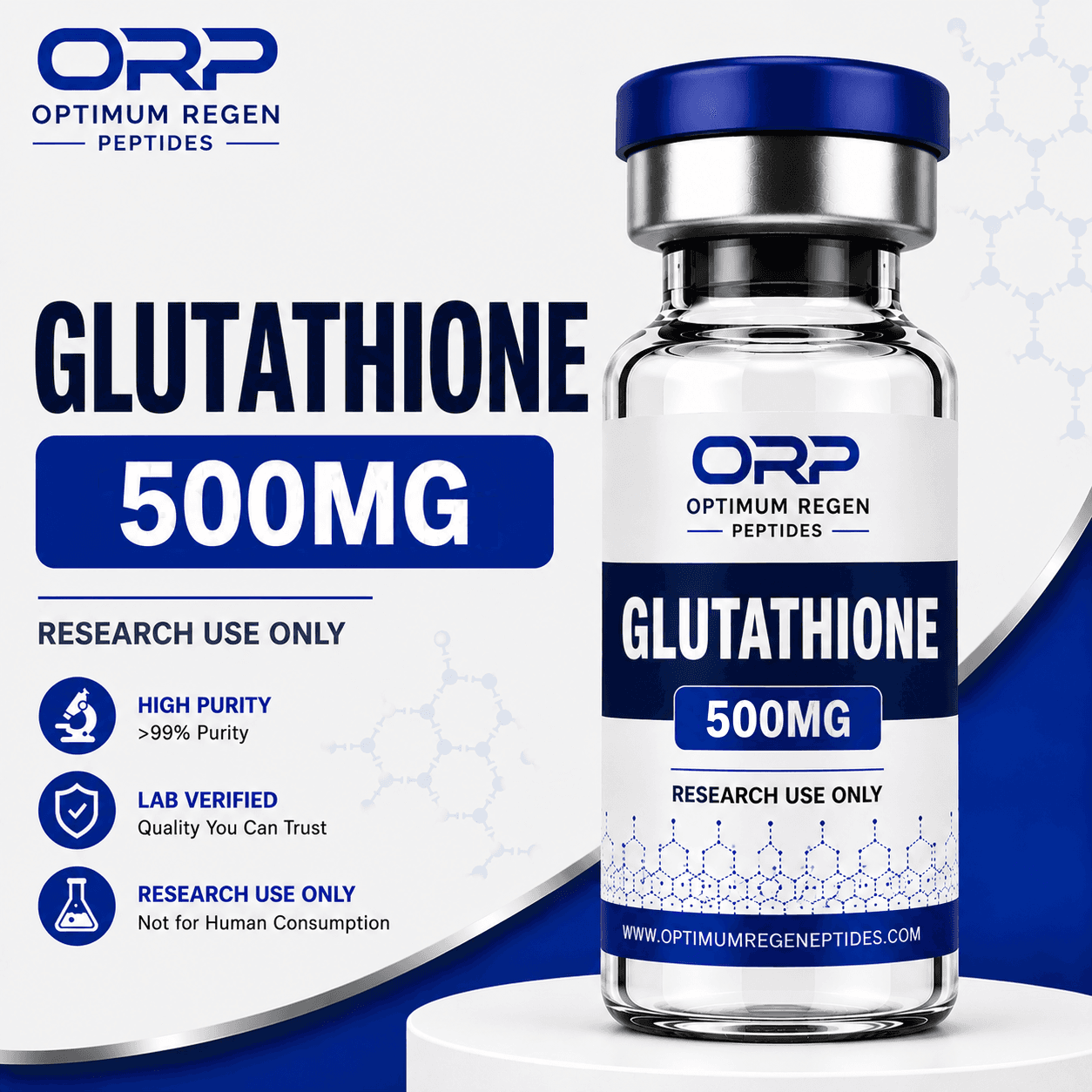
Glutathione
Compounded in a licensed US 503A pharmacy 🇺🇸
Antioxidant Research Compound.
Glutathione (gamma-L-glutamyl-L-cysteinyl-glycine) is a ubiquitous intracellular tripeptide and the primary endogenous antioxidant, studied in oxidative stress, detoxification, and redox-signaling research. Researchers investigate its role as a cofactor for glutathione peroxidase and S-transferase enzymes, and examine its involvement in xenobiotic metabolism and heavy metal chelation pathways in cell cultures. It is also studied in the context of immune cell function, mitochondrial integrity, and apoptosis regulation in laboratory models. Supplied as a stable lyophilized peptide of high analytical purity for laboratory investigation only. Store protected from light and moisture; reconstitute under aseptic conditions.
- Antioxidant research compound
- Lyophilized for stability
- Laboratory research only
Independently tested by Freedom Diagnostics using HPLC and mass spectrometry. The figure above is this batch's own measured result, not a target.
Glutathione · 500mg · White Cap · reported 07/06/2026
- 2-day shipping nationwide, flat $13
- Plain, discreet packaging. No product names on the outside.
- Tracking emailed the moment your order ships.
About Glutathione
Glutathione (GSH) is a tripeptide composed of glutamic acid, cysteine, and glycine that functions as the primary endogenous antioxidant in mammalian cells. It is synthesized intracellularly and exists in both reduced (GSH) and oxidized (GSSG) forms, with the ratio of these states serving as a key indicator of cellular redox balance that researchers use to assess oxidative stress in experimental systems.
In laboratory research, glutathione is extensively studied for its roles in phase II xenobiotic metabolism, where it conjugates with reactive electrophiles via glutathione S-transferase enzymes. Researchers also investigate its function in maintaining protein thiol homeostasis, regulating enzyme activity through protein glutathionylation, and serving as a cofactor for glutathione peroxidase enzymes that neutralize lipid peroxides and hydrogen peroxide.
Beyond its antioxidant functions, glutathione has been investigated as a signaling molecule involved in immune cell regulation, mitochondrial function, and apoptotic pathway modulation. Its depletion in tissue culture or animal models is used as an experimental tool to investigate oxidative stress mechanisms, while supplementation studies explore how restoration of GSH levels affects cellular function in research contexts.
Buy Glutathione online
Glutathione (GSH) is in stock and available to buy online from Optimum ReGen Peptides — a real American research-peptide company with a physical storefront in Medford, Oregon, not an anonymous overseas dropshipper. Priced from $60, every order ships within two business days, flat $13 nationwide, in plain discreet packaging with tracking.
As your Glutathione supplier we back every batch with a third-party certificate of analysis and compound in a licensed US 503A pharmacy. Vials are supplied lyophilized at analytical purity for laboratory and research use only, not for human consumption.
Researched For
Glutathione serves as the principal intracellular redox buffer, and researchers use GSH/GSSG ratios as quantitative markers of oxidative stress in cell culture models, tissue samples, and animal studies investigating disease-relevant conditions.
Laboratory studies have extensively characterized glutathione's role in phase II metabolism, where it conjugates with reactive drug metabolites and environmental toxicants via glutathione S-transferases, a pathway central to pharmacology and toxicology research.
Investigators have studied how intracellular glutathione levels influence lymphocyte proliferation, natural killer cell activity, and macrophage function in vitro, examining the connection between redox status and immune system signaling.
Research has examined the mitochondrial glutathione pool (mGSH) and its role in protecting the organelle from reactive oxygen species generated during oxidative phosphorylation, with studies investigating mGSH depletion in models of mitochondrial dysfunction.
Cell culture studies have investigated glutathione's interactions with tyrosinase, the rate-limiting enzyme in melanin synthesis, examining how reduced glutathione shifts melanocyte pigment production pathways at the biochemical level.
How It Is Studied
Glutathione levels in research samples are typically quantified using the DTNB (Ellman's reagent) colorimetric assay, HPLC with electrochemical or fluorescence detection, or mass spectrometry-based metabolomic panels. Researchers measure both total GSH and the GSH/GSSG ratio to characterize the redox environment of cells or tissue under experimental conditions.
Functional studies deplete cellular glutathione using buthionine sulfoximine (BSO), an inhibitor of gamma-glutamylcysteine synthetase, to create controlled oxidative stress models. Restoration experiments then introduce exogenous glutathione or precursors and measure recovery of redox markers, enzyme activity, and viability parameters, establishing causal relationships between GSH levels and cellular outcomes.
In vivo research uses animal models with targeted deletion of glutathione synthesis enzymes (e.g., Gclc knockout mice) or pharmacological depletion to study systemic consequences of GSH deficiency. Researchers use liquid chromatography-mass spectrometry to profile the glutathione metabolome (GSH, GSSG, protein-glutathione mixed disulfides, and metabolites) across tissues of interest.
Specifications
| Form | Lyophilized powder |
|---|---|
| Purity | >= 99% (HPLC) |
| Molecular Formula | C10H17N3O6S |
| Molar Mass | 307.3 g/mol |
| CAS Number | 70-18-8 |
| Sequence | gamma-Glu-Cys-Gly (non-standard peptide bond at glutamyl nitrogen) |
Storage & Handling
Lyophilized glutathione (reduced form) is hygroscopic and should be stored at -20°C in a tightly sealed container under inert atmosphere or desiccant to prevent oxidation. Exposure to air will convert GSH to GSSG; researchers should minimize headspace and handle with inert gas when possible.
Reconstituted glutathione solutions are chemically unstable in aqueous conditions at room temperature due to oxidation. Working solutions should be prepared fresh immediately before use or stabilized with EDTA (to chelate trace metals that catalyze oxidation) and stored at 4°C for a maximum of 24 hours. Long-term storage of solutions is not recommended in laboratory practice.
Frequently Asked Questions
What is the difference between reduced (GSH) and oxidized (GSSG) glutathione in research?+
Why is glutathione considered a central molecule in redox biology research?+
How is glutathione depletion used as a research tool?+
Is glutathione studied for skin biology applications?+
What analytical methods are used to measure glutathione in research samples?+
Related research compounds