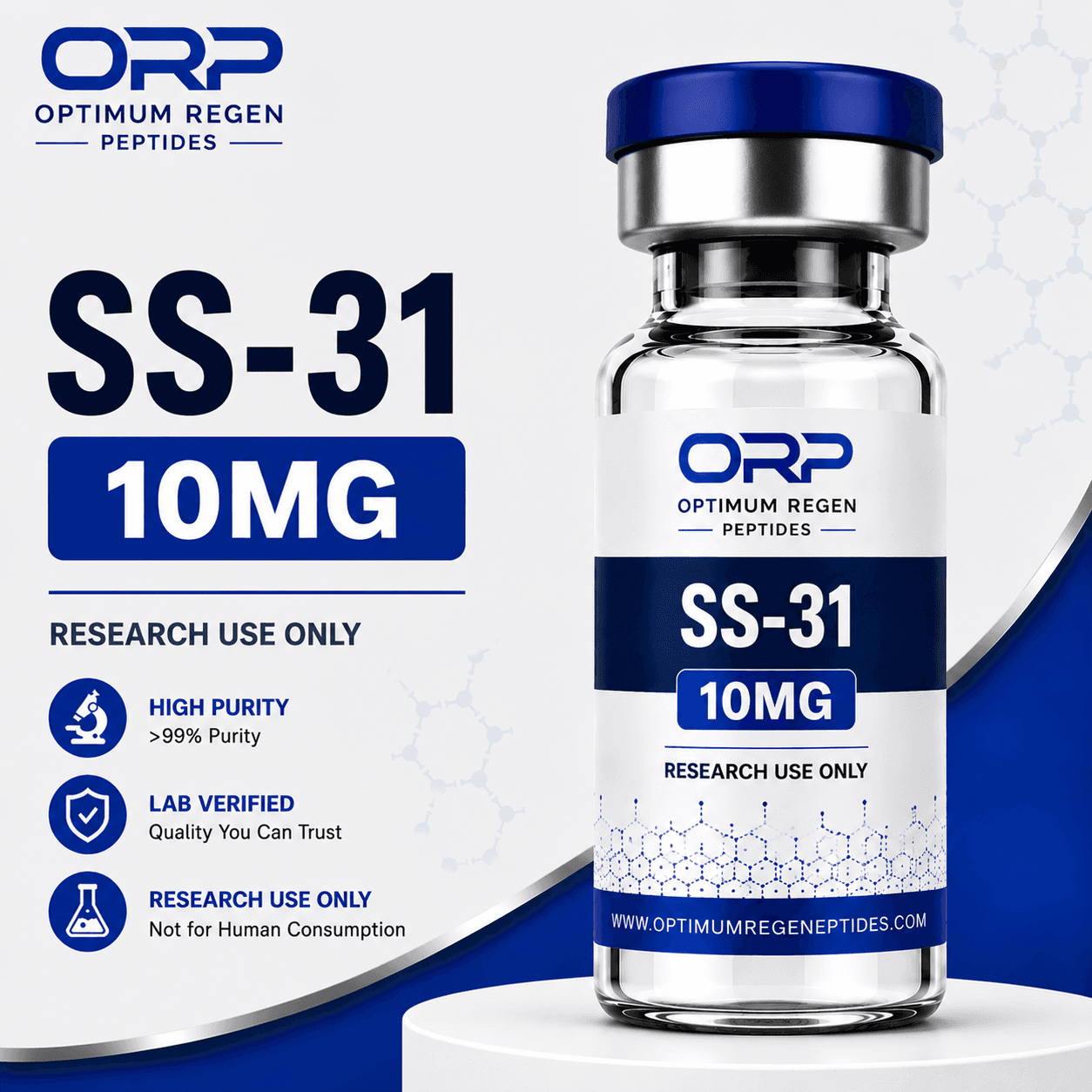
SS-31
Compounded in a licensed US 503A pharmacy 🇺🇸
Mitochondrial-Targeted Research Peptide.
SS-31 (Elamipretide, Szeto-Schiller peptide 31) is a mitochondria-targeting tetrapeptide (D-Arg-Dmt-Lys-Phe-NH2) studied in bioenergetics, oxidative stress, and cardiolipin-interaction research. Laboratory researchers investigate its affinity for cardiolipin in the inner mitochondrial membrane, its effects on electron transport chain efficiency, and its reduction of reactive oxygen species in in vitro and preclinical cellular stress models. It serves as a key tool compound in mitochondrial dysfunction research and is examined in aged and metabolically stressed cell line studies. Supplied as a stable lyophilized tetrapeptide of analytical purity for laboratory investigation only. Reconstitute under aseptic conditions and store at -80 degrees C.
- Mitochondrial research peptide
- Stable lyophilized powder
- Secure laboratory packaging
- Laboratory research only
Independently tested by Freedom Diagnostics using HPLC and mass spectrometry. The figure above is this batch's own measured result, not a target.
SS-31 · 10mg · White Cap · reported 07/06/2026
- 2-day shipping nationwide, flat $13
- Plain, discreet packaging. No product names on the outside.
- Tracking emailed the moment your order ships.
About SS-31
SS-31 is the common research designation for Elamipretide, also documented in the peptide science literature as Szeto-Schiller peptide 31, Bendavia, or MTP-131. Structurally it is a small aromatic-cationic tetrapeptide, D-Arg-Dmt-Lys-Phe-NH2, built from alternating positively charged and aromatic residues. That alternating sequence is the design feature researchers point to when explaining why SS-31 behaves differently from most peptides studied in cell biology: instead of acting at a surface receptor, it partitions directly into the inner mitochondrial membrane, which is the structural basis for calling it a mitochondrial-targeted peptide.
In laboratory research, SS-31 is studied primarily for its interaction with cardiolipin, a phospholipid found almost exclusively in the inner mitochondrial membrane and required for organizing the electron transport chain into functional supercomplexes. Investigators use SS-31 as a chemical probe to ask what changes when cardiolipin architecture is preserved under stress, tracking readouts such as membrane potential, cristae morphology by electron microscopy, and electron transport chain complex activity in isolated mitochondria and cultured cell models.
The Szeto-Schiller peptide series, named for the chemists who first characterized this class of aromatic-cationic peptides, was developed specifically to concentrate in mitochondria without relying on a delivery vehicle or targeting sequence. SS-31 is the most widely cited compound from that series in the published research record, and it is frequently referenced alongside related probes when researchers are mapping structure-activity relationships for mitochondrial-membrane-directed peptides.
A large share of the preclinical literature on SS-31, referred to as Elamipretide in that body of work, concerns oxidative stress and bioenergetic dysfunction models: ischemia-reperfusion protocols in isolated heart and kidney tissue, aged-cell and senescence models, and genetic cardiolipin-deficiency models such as Barth syndrome cell lines. Researchers in these settings typically quantify reactive oxygen species output with probes like MitoSOX or DCF-DA, and pair that with ATP production assays and oxygen consumption measurements to characterize mitochondrial respiratory function.
Because SS-31 and Elamipretide describe the same molecule, literature search strategies for this compound need to track both terms, along with Szeto-Schiller peptide 31 and MTP-131, to capture the full relevant dataset. This naming overlap is a frequent point of confusion for researchers building a bibliography, since older biochemistry papers tend to use the Szeto-Schiller or SS-31 designation while later publications adopt the Elamipretide name.
Optimum ReGen Peptides supplies SS-31 as a lyophilized research compound intended strictly for in vitro and preclinical laboratory use, not for human or animal administration. Each batch is compounded by a licensed US pharmacy and verified through independent third-party testing for identity and purity before it is made available to buy for research. Proper laboratory handling, aseptic reconstitution technique, and storage at the recommended temperature are the responsibility of the purchasing laboratory.
Buy SS-31 online
SS-31 (Elamipretide) is in stock and available to buy online from Optimum ReGen Peptides — a real American research-peptide company with a physical storefront in Medford, Oregon, not an anonymous overseas dropshipper. Priced from $60, every order ships within two business days, flat $13 nationwide, in plain discreet packaging with tracking.
As your SS-31 supplier we back every batch with a third-party certificate of analysis and compound in a licensed US 503A pharmacy. Vials are supplied lyophilized at analytical purity for laboratory and research use only, not for human consumption.
Researched For
SS-31's cardiolipin-binding property makes it a key research tool for studying the structural organization of the inner mitochondrial membrane, cristae morphology, and the supramolecular assembly of ETC complexes in laboratory models.
Research has investigated SS-31's effects on mitochondrial ROS generation, examining how its association with the inner membrane influences electron leak from ETC complex I and complex III in cell culture and isolated mitochondria preparations.
Preclinical research has used SS-31 in cardiac, renal, and neurological ischemia-reperfusion models to examine the impact of mitochondrial protection on cell survival, organ function, and biomarkers of oxidative injury.
Investigators have studied SS-31 in models of heart failure and cardiac hypertrophy to examine how mitochondrial function and cardiolipin integrity relate to energetic deficits observed in these disease states.
Research has used SS-31 in aged animal models and senescent cell cultures to investigate whether restoring mitochondrial membrane integrity can reverse age-associated declines in bioenergetics and mitochondrial quality control processes.
How It Is Studied
In laboratory research, SS-31 is applied to isolated mitochondria preparations, cell cultures, or living cells to examine its effects on mitochondrial membrane potential (assessed by JC-1 or TMRE fluorescence), oxygen consumption rate (measured by Seahorse XF analysis), and ROS generation (measured by MitoSOX or analogous fluorescent probes).
Preclinical in vivo studies administer SS-31 to rodents before or after ischemic insults, measuring cardiac function by echocardiography and pressure-volume loop analysis, renal function by creatinine and BUN levels, and tissue histology to assess the extent of injury and any protective effects associated with treatment.
Biochemical studies use blue native PAGE and electron microscopy to examine ETC complex superassembly and cristae ultrastructure in mitochondria treated with SS-31, providing structural correlates for observed functional improvements in bioenergetics assays. Cardiolipin content and acyl chain composition are measured by mass spectrometry to characterize the lipid environment of the IMM.
Specifications
| Form | Lyophilized powder |
|---|---|
| Purity | >= 99% (HPLC) |
| Sequence | D-Arg-Dmt-Lys-Phe-NH2 |
| Molecular Formula | C32H49N9O5 |
| Molar Mass | 639.80 g/mol |
Storage & Handling
Lyophilized SS-31 should be stored at -20 °C in a sealed, desiccated vial protected from direct light. The lyophilized peptide is stable under these conditions for extended periods. For cell-based research, SS-31 is commonly reconstituted in sterile water, PBS, or DMSO (for hydrophobic assay contexts) to prepare stock solutions.
Reconstituted SS-31 solutions should be aliquoted into single-experiment volumes and stored at -80 °C if not used immediately. Avoid repeated freeze-thaw cycles, which can lead to peptide aggregation and loss of activity. Verify peptide integrity by HPLC for long-running research programs where stock stability is a concern.
Frequently Asked Questions
What is SS-31?+
Is SS-31 the same thing as Elamipretide?+
What is a mitochondrial-targeted peptide?+
Who developed the Szeto-Schiller peptide series?+
Where can I buy SS-31 for research use?+
What is the chemical structure of SS-31?+
What is SS-31 elamipretide research used for in the lab?+
Is it legal to purchase SS-31 peptide for research?+
How does SS-31 differ from other mitochondrial research peptides like MOTS-c or humanin?+
What purity and testing should a research-grade SS-31 peptide have?+
Related research compounds