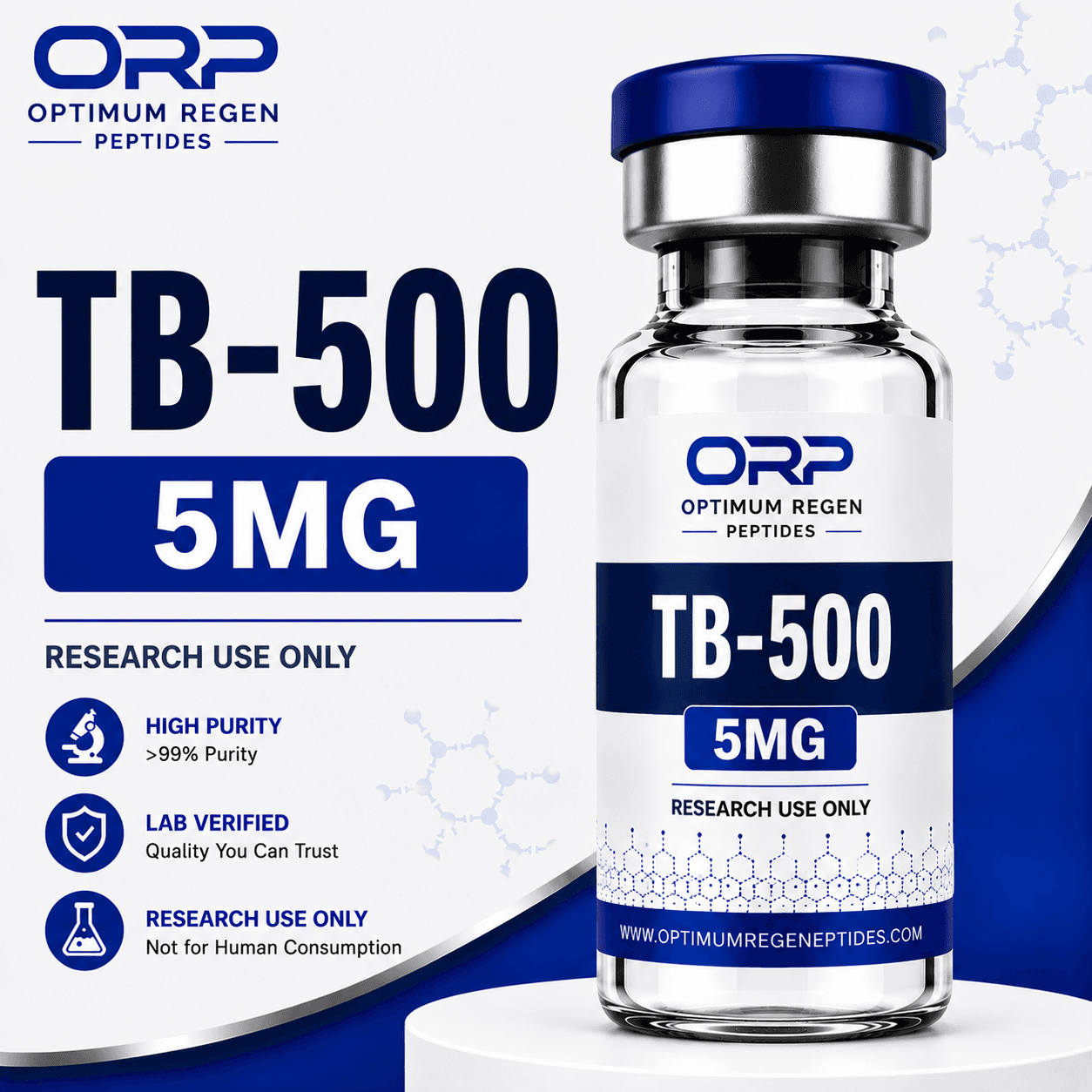
TB-500
Compounded in a licensed US 503A pharmacy 🇺🇸
Thymosin Beta-4 Research Peptide.
TB-500 is a synthetic analogue of Thymosin Beta-4, a 43-amino-acid actin-sequestering protein studied extensively in cell migration, angiogenesis, and tissue repair biology research. Laboratory investigators examine its binding to G-actin monomers, its effects on endothelial and fibroblast cell motility in scratch-wound assays, and its modulation of anti-inflammatory gene expression in preclinical cell culture models. It is a widely referenced tool peptide in regenerative biology literature, employed in tendon fibroblast, cardiomyocyte, and neural cell studies. Supplied as a lyophilized peptide of analytical purity for laboratory investigation only. Store at -20 degrees C and reconstitute under sterile conditions.
- Lyophilized for stability
- Research-grade compound
- Laboratory research only
Independently tested by Freedom Diagnostics using HPLC and mass spectrometry. We have not published a certificate for this product yet, so no purity figure is shown here. Every vial carries an accession number you can look up directly with the lab.
- 2-day shipping nationwide, flat $13
- Plain, discreet packaging. No product names on the outside.
- Tracking emailed the moment your order ships.
About TB-500
TB-500 is a synthetic peptide derived from the central actin-binding domain of thymosin beta-4 (Tb4), a 43-amino acid protein ubiquitously expressed in mammalian cells. The specific fragment studied as TB-500 corresponds primarily to the conserved LKKTETQ motif, which has been identified as the principal actin-sequestering and cell-migration-promoting sequence of the full thymosin beta-4 molecule.
Thymosin beta-4 is the most abundant G-actin-sequestering protein in eukaryotic cells, with intracellular concentrations estimated at 200-500 micromolar. It was originally characterized in thymic tissue but is now known to be expressed widely in platelets, neutrophils, cardiac tissue, and most other cell types. Its core biological activity involves maintaining the pool of unpolymerized actin available for rapid cytoskeletal remodeling in response to cellular signals.
Research into TB-500 and the broader thymosin beta-4 system has expanded significantly since studies in the early 2000s demonstrated that Tb4 is secreted from platelets at wound sites and exerts extracellular effects on tissue repair processes. Investigators have since examined angiogenesis, anti-inflammatory signaling, and cardiomyocyte protection in both in vitro and animal model contexts using TB-500 as a pharmacological probe.
Buy TB-500 online
TB-500 (Thymosin Beta-4) is in stock and available to buy online from Optimum ReGen Peptides — a real American research-peptide company with a physical storefront in Medford, Oregon, not an anonymous overseas dropshipper. Priced from $35, every order ships within two business days, flat $13 nationwide, in plain discreet packaging with tracking.
As your TB-500 supplier we back every batch with a third-party certificate of analysis and compound in a licensed US 503A pharmacy. Vials are supplied lyophilized at analytical purity for laboratory and research use only, not for human consumption.
Researched For
TB-500's LKKTETQ motif is studied as a structural probe for understanding G-actin sequestration mechanisms, actin treadmilling dynamics, and the regulation of cellular actin pools that drive migration, division, and morphological changes in primary cell cultures.
Preclinical studies have examined TB-500 in excisional wound models, surgical incision models, and corneal injury paradigms, measuring re-epithelialization rates, granulation tissue formation, and angiogenic vessel density as research endpoints.
A significant body of research has investigated thymosin beta-4 and TB-500 in cardiac injury models, examining cardiomyocyte survival signaling (ILK-Akt pathway), angiogenic sprouting in the myocardium, and cardiac progenitor cell mobilization in ischemia-reperfusion and myocardial infarction models.
Tube formation assays, matrigel plug experiments, and chorioallantoic membrane models have been used to study TB-500's pro-angiogenic properties, with researchers investigating VEGF receptor signaling and endothelial cell migration as downstream mechanisms.
Investigators have studied TB-500 in models of spinal cord injury, traumatic brain injury, and peripheral nerve damage, examining axonal regeneration markers, oligodendrocyte maturation, and functional recovery measures in controlled animal studies.
How It Is Studied
In vitro wound healing research uses standardized scratch assays in primary keratinocyte, fibroblast, or endothelial cell monolayers, quantifying cell migration rates into the wound area with time-lapse microscopy. Actin polymerization state is assessed by differential ultracentrifugation (G-actin vs. F-actin fractions) and fluorescence-labeled phalloidin staining of cytoskeletal organization.
Cardiac research employs isolated neonatal rat ventricular cardiomyocytes (NRVCMs) exposed to hypoxia/reoxygenation to model ischemic injury, with TB-500 introduced at defined concentrations. Outcome measures include viability assays (LDH release, live/dead staining), ILK and Akt phosphorylation by Western blot, and mitochondrial function via JC-1 staining. In vivo studies use coronary artery ligation in rodents with serial echocardiography to track cardiac function.
Angiogenesis studies use HUVEC tube formation assays on growth factor-reduced matrigel, quantifying tube length, junction number, and mesh area by automated image analysis. VEGFR2 phosphorylation and downstream ERK/Akt signaling are characterized by immunoprecipitation and Western blot, establishing the molecular basis of TB-500's endothelial cell effects in these laboratory systems.
Specifications
| Form | Lyophilized powder |
|---|---|
| Purity | >= 99% (HPLC) |
| Molecular Formula | C212H350N56O78S |
| Molar Mass | 4963.5 g/mol |
| CAS Number | 77591-33-4 |
Storage & Handling
Lyophilized TB-500 should be stored at -20°C, protected from light and moisture. Under these conditions, the lyophilized peptide maintains structural integrity for extended periods. Vials should be sealed and equilibrated to room temperature under desiccant before handling to prevent water vapor absorption.
Reconstituted TB-500 solutions for laboratory use should be prepared in sterile bacteriostatic water or PBS and held at 4°C for use within 48 to 72 hours. Researchers should prepare aliquots to avoid repeated freeze-thaw cycles, which promote peptide aggregation. Adsorption to low-binding plasticware is recommended when working at low nanomolar concentrations.
Frequently Asked Questions
What is the relationship between TB-500 and full-length thymosin beta-4?+
What is the LKKTETQ motif and why is it significant in research?+
Has TB-500 been studied in cardiac research?+
How does TB-500 differ from BPC-157 in research models?+
What in vivo models are used for TB-500 research?+
Related research compounds