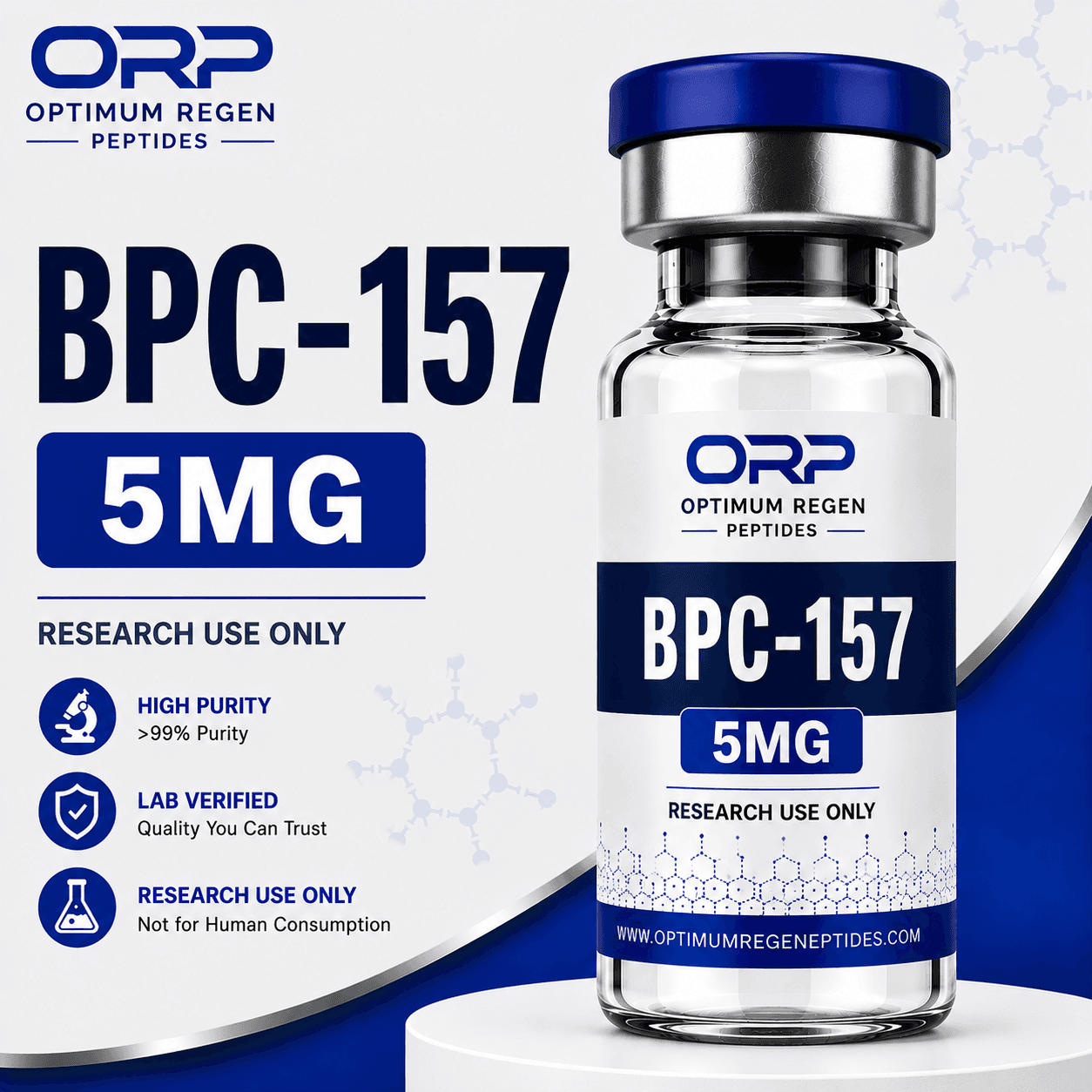
BPC-157
Compounded in a licensed US 503A pharmacy 🇺🇸
Peptide Research Compound.
BPC-157 (Body Protective Compound-157) is a synthetic pentadecapeptide derived from a gastric juice protein, extensively studied in cellular repair and angiogenesis research models. Laboratory investigations have examined its interactions with growth factor signaling, nitric oxide pathways, and fibroblast activity in tissue culture and preclinical contexts. It is among the most widely referenced peptides in regenerative biology literature, appearing in studies on tendon, muscle, and gastrointestinal cell lines. Supplied in stable lyophilized format at analytical purity for laboratory investigation only. Reconstitute with bacteriostatic water under sterile conditions prior to use.
- Lyophilized for stability
- Research-grade compound
- Laboratory research only
Independently tested by Freedom Diagnostics using HPLC and mass spectrometry. We have not published a certificate for this product yet, so no purity figure is shown here. Every vial carries an accession number you can look up directly with the lab.
- 2-day shipping nationwide, flat $13
- Plain, discreet packaging. No product names on the outside.
- Tracking emailed the moment your order ships.
About BPC-157
BPC-157 (Body Protection Compound-157) is a pentadecapeptide consisting of 15 amino acids, derived from a partial sequence of human gastric juice protein BPC. It was first described in the early 1990s, and since then has been extensively studied in preclinical models for its effects on tissue repair, angiogenesis, and gastrointestinal function.
A substantial body of peer-reviewed research, largely conducted in rodent models, has investigated BPC-157's interactions with the nitric oxide (NO) system, growth hormone receptors, and vascular endothelial growth factor (VEGF) pathways. These studies have examined its stability in gastric acid and its systemic availability following different routes of administration in controlled laboratory settings.
BPC-157 has attracted significant scientific attention due to its apparent multi-tissue activity in research models, with studies spanning tendon, muscle, bone, nerve, and gastrointestinal tissue. Its mechanism of action remains an active area of investigation, with researchers exploring interactions between this peptide and multiple signaling networks involved in cellular repair and cytoprotection.
Buy BPC-157 online
BPC-157 (Body Protection Compound 157) is in stock and available to buy online from Optimum ReGen Peptides — a real American research-peptide company with a physical storefront in Medford, Oregon, not an anonymous overseas dropshipper. Priced from $35, every order ships within two business days, flat $13 nationwide, in plain discreet packaging with tracking.
As your BPC-157 supplier we back every batch with a third-party certificate of analysis and compound in a licensed US 503A pharmacy. Vials are supplied lyophilized at analytical purity for laboratory and research use only, not for human consumption.
Researched For
BPC-157 has been among the most frequently studied peptides in tendon healing research, with numerous animal studies examining how it affects fibroblast proliferation, collagen organization, and the speed of structural repair in severed or damaged tendon tissue.
Research has studied BPC-157 in models of gastric ulceration, inflammatory bowel conditions, and intestinal anastomosis, investigating its cytoprotective properties and interactions with the gut lining at the cellular level.
Laboratory studies have examined BPC-157's role in stimulating new blood vessel formation, with researchers investigating its modulation of VEGF expression and endothelial cell activity in wound healing and ischemia models.
Multiple preclinical studies have investigated BPC-157 in crush injury and transection muscle models, examining myocyte repair kinetics, satellite cell activity, and functional recovery metrics in controlled laboratory settings.
Investigators have studied BPC-157 in peripheral and central nervous system injury models, examining axonal regeneration rates, neuroprotective markers, and behavioral outcomes in animal subjects under research protocols.
How It Is Studied
BPC-157 research in tendon and muscle models typically involves surgical transection or crush injury in rodents, followed by localized or systemic administration of the peptide. Outcome measures include biomechanical tensile strength testing of repaired tissue, histological scoring of collagen fiber organization, and immunohistochemical staining for fibroblast and endothelial cell markers.
Gastrointestinal studies employ chemically induced lesion models (cysteamine, indomethacin, alcohol) in rats, with BPC-157 administered before or after injury. Researchers measure lesion area via endoscopic or gross pathology examination, alongside molecular markers of inflammation such as TNF-alpha, IL-1 beta, and COX-2 expression in gastric tissue samples.
Angiogenesis experiments use tube formation assays in human umbilical vein endothelial cells (HUVECs), matrigel plug assays in mice, and VEGF protein quantification via Western blot to characterize BPC-157's vascular effects. Researchers compare dose-dependent responses to establish concentration-effect relationships in these in vitro systems.
Specifications
| Form | Lyophilized powder |
|---|---|
| Purity | >= 99% (HPLC) |
| Molecular Formula | C62H98N16O22 |
| Molar Mass | 1419.5 g/mol |
| CAS Number | 137525-51-0 |
| Sequence | Gly-Glu-Pro-Pro-Pro-Gly-Lys-Pro-Ala-Asp-Asp-Ala-Gly-Leu-Val |
Storage & Handling
Lyophilized BPC-157 research material should be stored at -20°C, kept away from humidity and UV exposure. The peptide is stable for extended periods in this state when the vial remains sealed and the cold chain is maintained.
After reconstitution in a sterile aqueous vehicle for laboratory use, BPC-157 solutions should be held at 4°C and used within 48 hours. Repeated freeze-thaw cycles compromise peptide integrity; single-use aliquots are the standard laboratory practice to maintain experimental reproducibility.