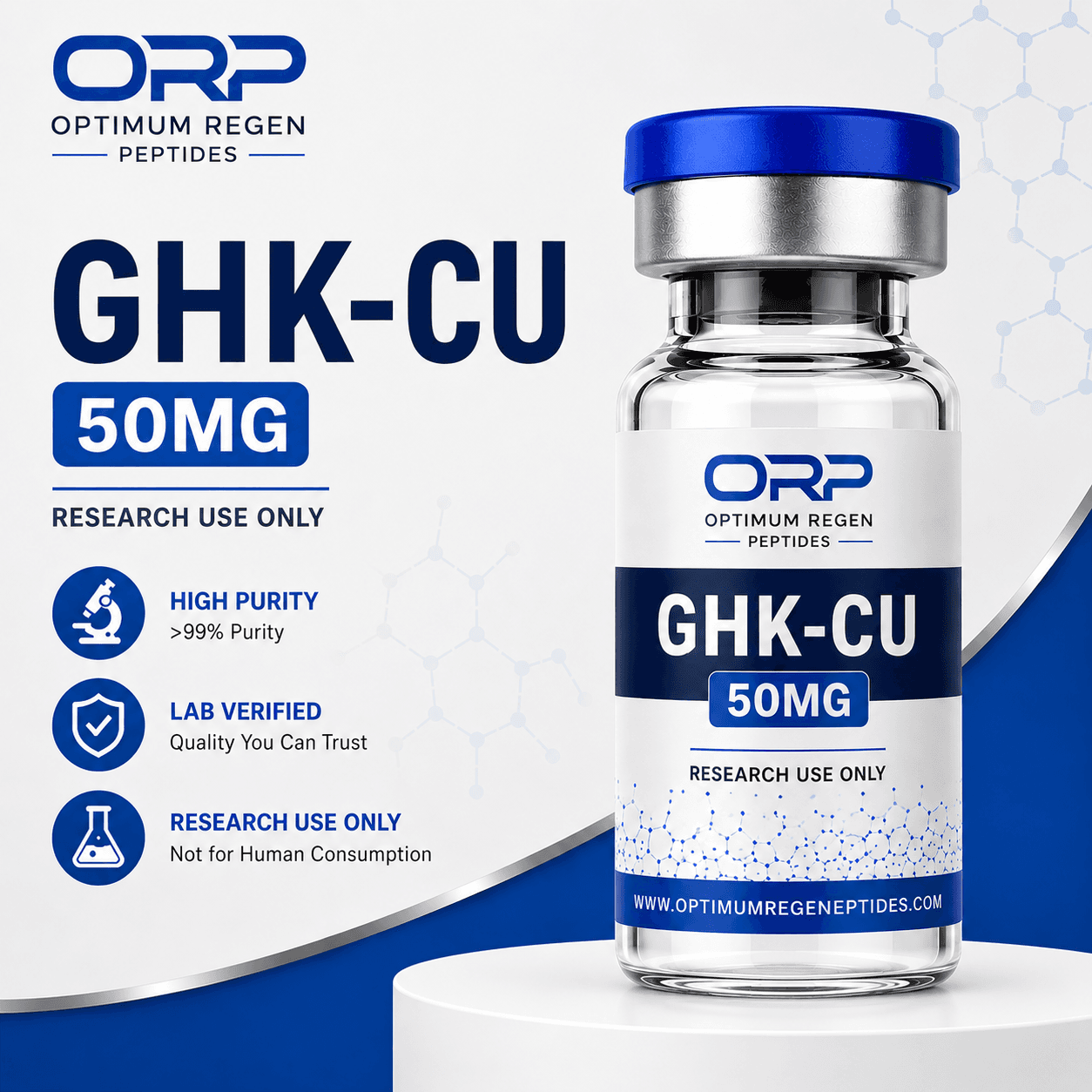
GHK-Cu
Compounded in a licensed US 503A pharmacy 🇺🇸
Collagen-supporting peptide for skin & recovery.
GHK-Cu (Glycyl-L-histidyl-L-lysine copper complex) is a naturally occurring copper-binding tripeptide found in human plasma, studied extensively in wound healing, skin remodeling, and antioxidant biology research. Laboratory investigations examine its roles in stimulating collagen and glycosaminoglycan synthesis in fibroblast cultures, as well as its modulation of matrix metalloproteinase activity in tissue repair models. Researchers also investigate its interactions with gene expression networks associated with cellular repair and inflammation in controlled in vitro settings. Supplied as a lyophilized copper peptide complex of analytical purity for laboratory research use only. For in vitro and preclinical investigation; not for cosmetic or personal use unless expressly labeled.
- Supports skin and tissue repair routines
- Popular in cosmetic and recovery protocols
- Easy to stack with wellness basics
Independently tested by Freedom Diagnostics using HPLC and mass spectrometry. The figure above is this batch's own measured result, not a target.
GHK-Cu · 50mg · Blue Cap · reported 04/29/2026
- 2-day shipping nationwide, flat $13
- Plain, discreet packaging. No product names on the outside.
- Tracking emailed the moment your order ships.
About GHK-Cu
GHK-Cu (Glycyl-L-Histidyl-L-Lysine copper complex) is a naturally occurring tripeptide-copper complex first isolated from human plasma. It is found in saliva, urine, and various tissues and its concentrations in plasma decline with age. The compound has been extensively studied in cell biology and wound-healing research for its interactions with copper-binding proteins and its reported influence on gene expression profiles.
Research published over several decades indicates that GHK-Cu modulates a broad array of biological processes at the cellular level. Studies have examined its effects on fibroblast activity, extracellular matrix remodeling, antioxidant enzyme expression, and angiogenesis-related signaling pathways. Its small size and copper-chelating structure facilitate cellular uptake in laboratory models.
As a research compound, GHK-Cu is investigated in contexts ranging from tissue biology to skin model research and gene regulation studies. It is intended strictly for laboratory use and is not approved as a pharmaceutical or therapeutic agent.
Buy GHK-Cu online
GHK-Cu (Copper Peptide GHK-Cu) is in stock and available to buy online from Optimum ReGen Peptides — a real American research-peptide company with a physical storefront in Medford, Oregon, not an anonymous overseas dropshipper. Priced from $35, every order ships within two business days, flat $13 nationwide, in plain discreet packaging with tracking.
As your GHK-Cu supplier we back every batch with a third-party certificate of analysis and compound in a licensed US 503A pharmacy. Vials are supplied lyophilized at analytical purity for laboratory and research use only, not for human consumption.
Researched For
Laboratory studies have investigated GHK-Cu's ability to stimulate fibroblast migration and proliferation, and to influence collagen and glycosaminoglycan synthesis in cell culture models.
In vitro studies have examined GHK-Cu's influence on the expression of superoxide dismutase and other antioxidant enzymes, providing insights into copper-mediated redox signaling.
GHK-Cu has been studied in animal wound models and ex vivo tissue preparations to investigate how the peptide-copper complex affects tissue repair processes at the cellular level.
Microarray and transcriptomic analyses have shown that GHK-Cu modulates the expression of hundreds of genes in human fibroblasts, with research interest in understanding which regulatory networks are engaged.
Cell-based assays have been used to study GHK-Cu's relationship with VEGF and related angiogenic factors, exploring the compound's role in vascular biology research models.
How It Is Studied
In cell culture systems, GHK-Cu is typically applied to fibroblast or keratinocyte monolayers at nanomolar to micromolar concentrations. Researchers measure outcomes such as cell proliferation rate, migration assay results, collagen secretion (via ELISA or hydroxyproline assay), and gene expression changes via quantitative PCR or transcriptomics.
Animal models of wound healing have been employed to assess how GHK-Cu applied to wound sites influences closure rates, tissue architecture, and collagen deposition histologically. These models help contextualize the in vitro findings within a more complex biological environment.
The tripeptide's copper-binding stoichiometry (1:1 Cu2+ to GHK) is studied using spectroscopic methods. Researchers characterize the stability constants, redox behavior, and cellular uptake mechanisms of the Cu complex to understand the molecular basis of its observed biological activities.
Specifications
| Form | Lyophilized powder |
|---|---|
| Purity | >= 99% (HPLC) |
| Molecular Formula | C14H23CuN6O4 |
| CAS Number | 89030-95-5 |
| Sequence | Gly-His-Lys (copper complex) |
| Molar Mass | 403.91 g/mol |
Storage & Handling
Store lyophilized GHK-Cu at -20 C, protected from light and humidity. The compound's copper coordination is stable in the dry state. Once reconstituted in sterile water or buffer, store at 4 C for short-term use (up to one week) or aliquot and freeze at -80 C to minimize copper dissociation and peptide degradation. Avoid prolonged exposure to strong oxidizing conditions. Maintain an audit log of lot, reconstitution date, and storage conditions per laboratory protocol.
Frequently Asked Questions
What is the copper stoichiometry in GHK-Cu?+
At what concentrations is GHK-Cu typically used in cell culture studies?+
Is GHK-Cu the same compound as copper peptide used in cosmetics?+
How does GHK-Cu influence gene expression in research models?+
What is the stability of reconstituted GHK-Cu?+
Related research compounds