0104 areas
Melanocortin receptor pharmacology
Binding and activation at melanocortin receptors, compared across related cyclic peptides.

All research products on this site, including all peptides, are sold strictly for laboratory and research use only, not for human or animal consumption, diagnostic, or therapeutic use. Our tallow skincare products are topical cosmetics. You must be 21 or older to enter.
By entering you confirm you are 21+ and accept these products are for research use only. See our Terms and Disclaimer.
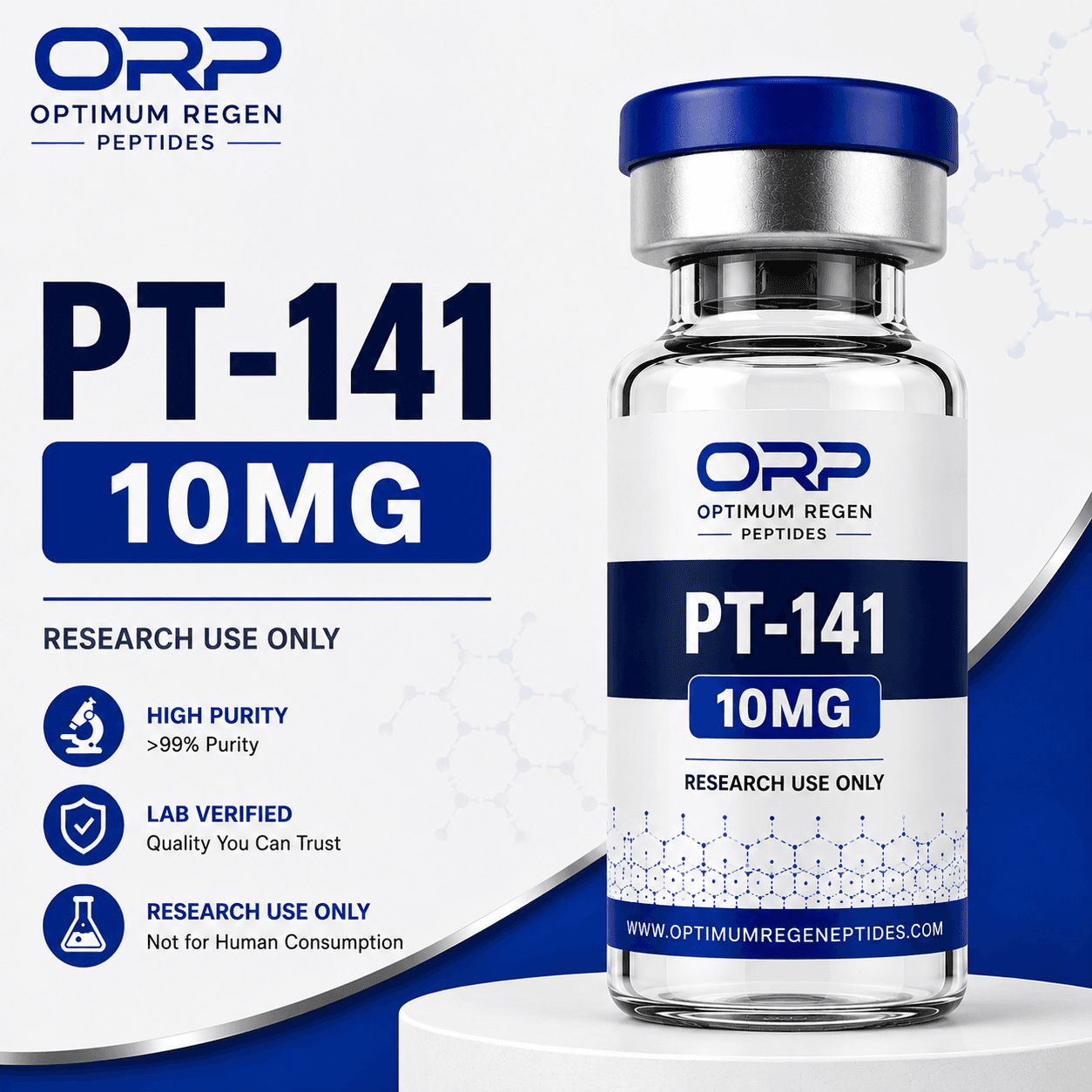
A cyclic seven-residue melanocortin peptide, lyophilized. Sold in 10mg vials for laboratory research.
Complete the order
Supplies and compounds researchers add to this order
Identity, purity and handling data for this compound, in one place. Tap an identifier to copy it.
For research use only. Not for human consumption.
PT-141 is a small ring-shaped peptide that activates melanocortin receptors, a family of receptors involved in signaling in the brain and elsewhere. It is mainly used in research on the melanocortin-4 receptor (MC4R) in the central nervous system.
It has seven residues, a molar mass of 1025.2 g/mol and CAS number 189691-06-3; the full structure and identifiers are in the lab sheet above. ORP supplies it as a lyophilized powder for in vitro and preclinical research only. It is not for human or animal use and is not intended to diagnose, treat, cure, or prevent any disease.
PT-141 is closely related to Melanotan II (MT-2), another cyclic melanocortin peptide. The two share the same ring and N-terminus; the difference is at the C-terminus, where PT-141 carries a free carboxylic acid and Melanotan II an amide. That one change is visible in their formulas: C50H68N14O10 for PT-141 against C50H69N15O9 for Melanotan II. Researchers use the pair to compare how small structural changes alter activity at melanocortin receptors.
Both peptides belong to the melanocortin family of research compounds, which act at melanocortin receptors (MC1R through MC5R). Research on PT-141 has focused on the melanocortin-4 receptor (MC4R) in the central nervous system and its role in hypothalamic and autonomic signaling, studied in receptor-binding assays, cell systems and animal models.
Identity is usually confirmed against the formula and a molar mass of about 1,025 by mass spectrometry, with purity by HPLC. ORP's 10mg PT-141 lot has a published third-party certificate of analysis from Freedom Diagnostics reporting 99.77% purity and a measured net content of 9.62 mg (reported 08/11/2026, accession 2608060835), shown on this page. Review the report against the product and lot before relying on it in your work.
The areas where this compound appears in the published research literature.
Published PT-141 work uses receptor-binding and activation assays at melanocortin receptors, cell systems expressing those receptors, and animal models of central melanocortin signaling.
Identity is confirmed against the formula and molar mass by mass spectrometry, and purity by HPLC. Each research protocol sets its own model, controls, concentrations and handling; this listing supplies the compound, not a protocol.
Store lyophilized PT-141 at -20°C, sealed and protected from light and moisture. Let the vial reach room temperature before opening so moisture does not condense on the powder.
Reconstituted peptide solutions are commonly held at 2-8°C and divided into single-use aliquots to avoid repeated freeze-thaw cycles. Validate the solvent, concentration and use period for your own protocol.
PT-141 for sale from Optimum ReGen Peptides, a US research-peptide company with a storefront in Medford, Oregon. It is in stock, priced from $50. Every order ships 2-Day Priority Air, a $13 flat rate anywhere in the US, with tracking, or can be picked up at the store.
The current batch has a published third-party certificate of analysis, shown above. PT-141 is supplied as lyophilized powder, for laboratory and research use only, not for human consumption.