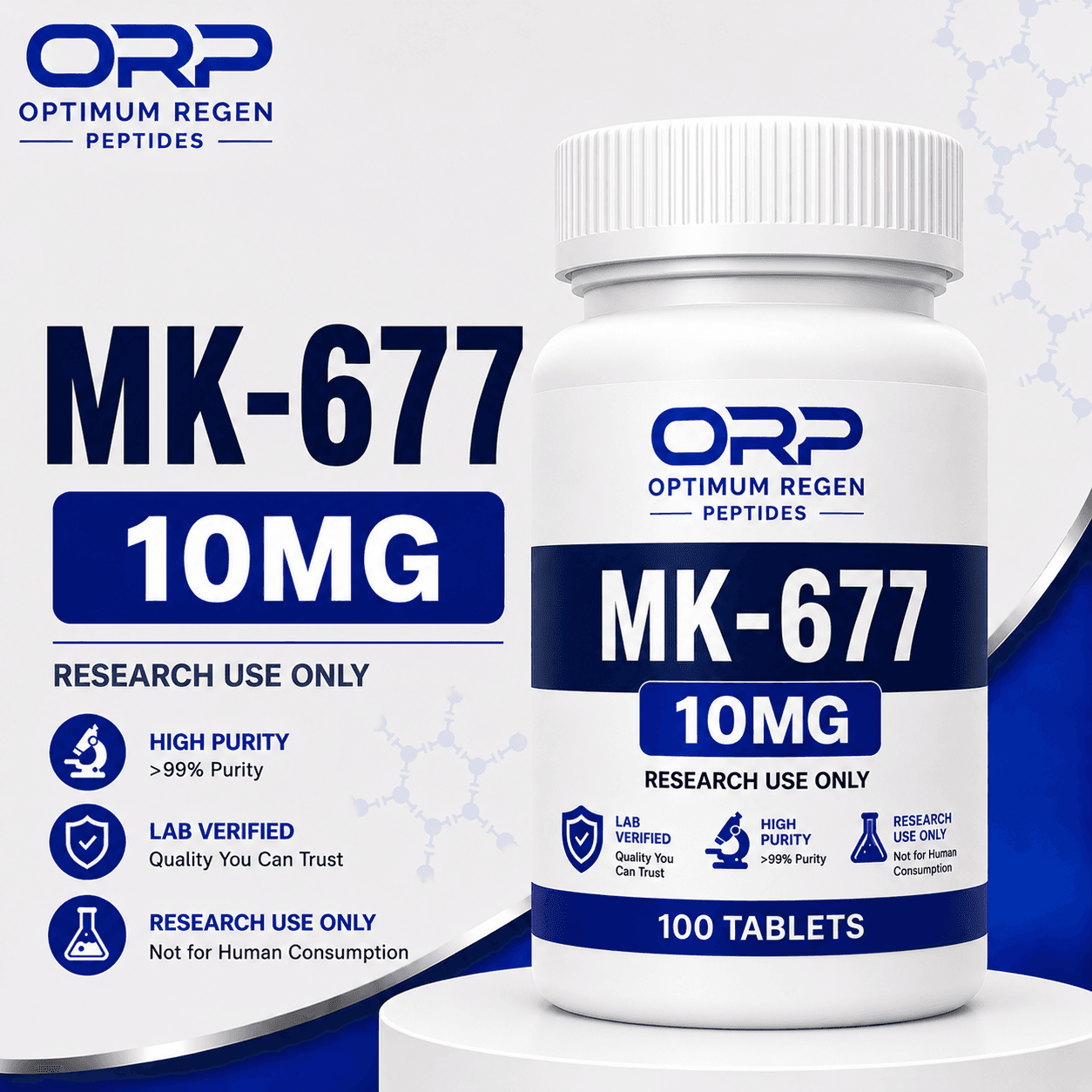
MK-677
Compounded in a licensed US 503A pharmacy 🇺🇸
Growth Hormone Secretagogue Research Compound.
MK-677 (Ibutamoren mesylate) is an orally active, non-peptide ghrelin receptor (GHS-R1a) agonist and growth hormone secretagogue investigated in GH/IGF-1 axis research models. Preclinical researchers study its ability to stimulate sustained GH pulsatility and elevate circulating IGF-1 levels in animal models without directly affecting cortisol, providing a selective research tool for somatotropic axis studies. It is also investigated in bone metabolism and nitrogen balance research in preclinical laboratory settings. Supplied in precision-measured tablet format for controlled laboratory investigation. For research use only; not intended for human or veterinary use.
- 10mg tablet format
- Research-grade formulation
- Precision-measured tablets
- Laboratory research only
Independently tested by Freedom Diagnostics using HPLC and mass spectrometry. We have not published a certificate for this product yet, so no purity figure is shown here. Every vial carries an accession number you can look up directly with the lab.
- 2-day shipping nationwide, flat $13
- Plain, discreet packaging. No product names on the outside.
- Tracking emailed the moment your order ships.
About MK-677
MK-677 is not a peptide. Chemically designated ibutamoren, and frequently referenced by its mesylate salt form, MK-677 is classified in pharmacological research literature as a non-peptide, orally bioavailable small molecule that functions as a ghrelin receptor agonist and growth hormone secretagogue. The distinction matters for researchers: growth hormone secretagogue is a functional category that includes both peptide compounds, such as GHRP-6, GHRP-2, hexarelin, ipamorelin, and sermorelin, and non-peptide small molecules like MK-677, and conflating the broader category with the peptide subclass is a common source of confusion in searches on this compound.
Structurally, MK-677 lacks the amino-acid backbone that defines a peptide. Its molecular formula, C27H36N4O5S, with a molar mass of approximately 528.7 g/mol, and its CAS registry number, 159634-47-6, are used across certificates of analysis to confirm compound identity ahead of any research protocol. Because it is a small organic molecule rather than a chain of amino acid residues, MK-677 is grouped separately from peptide-class ghrelin agonists in structural classification schemes, even though both classes are studied for overlapping receptor pharmacology.
In laboratory research, MK-677 is investigated as a ghrelin mimetic: it binds the growth hormone secretagogue receptor, GHS-R1a, with high affinity, engaging the same receptor pathway as endogenous ghrelin but without the rapid enzymatic deacylation that limits native ghrelin's utility as a research tool. Downstream, this receptor activation is studied for its role in pulsatile growth hormone release from the pituitary and subsequent hepatic IGF-1 production, positioning MK-677 as a reference compound in GH/IGF-1 axis research models. Its mechanism is described in the literature strictly in terms of receptor-binding pharmacology and signaling cascades observed in research systems.
Because MK-677 and peptide GH secretagogues converge on the same receptor target, researchers and search queries frequently group them together, which is the likely source of the recurring is MK-677 a peptide question. Peptide secretagogues under research investigation, including GHRP-6, GHRP-2, hexarelin, and ipamorelin, are short sequences of amino acids typically studied via reconstituted, injectable research protocols. MK-677 occupies a separate structural class as a non-peptide, orally studied small molecule, a distinction researchers rely on when documenting compound class or designing comparative GHS-R1a studies.
Beyond receptor pharmacology, MK-677 research spans several domains: GH/IGF-1 axis dynamics and pituitary secretory patterns, bone metabolism and turnover biomarkers, nitrogen balance and lean tissue parameters in preclinical models, and sleep architecture, particularly slow-wave and REM sleep stages recorded via polysomnography in research models. Ghrelin receptor pharmacology more broadly, including appetite-signaling pathways studied in animal models, is also a documented area of MK-677 investigation. All such findings are drawn from laboratory and preclinical literature and describe research-model observations rather than outcomes in human users.
MK-677 was originally developed under the research code MK-0677 in the mid-1990s as a non-peptide, orally active alternative to peptide GH secretagogues that otherwise required reconstitution and injection. Published research literature since that period has examined the compound's ghrelin receptor pharmacology and GH/IGF-1 axis effects, building a body of preclinical research literature that continues to inform current laboratory research design.
Optimum ReGen Peptides supplies MK-677 (ibutamoren) as a third-party tested research compound, with certificates of analysis confirming identity and purity by HPLC. Every batch is compounded through a licensed US pharmacy and distributed strictly for laboratory research use. MK-677 is not for human consumption, is not evaluated by the FDA for any medical use, and is not intended to diagnose, treat, cure, or prevent any disease; nothing on this page constitutes medical advice.
Buy MK-677 online
MK-677 (Ibutamoren) is in stock and available to buy online from Optimum ReGen Peptides — a real American research-peptide company with a physical storefront in Medford, Oregon, not an anonymous overseas dropshipper. Priced from $120, every order ships within two business days, flat $13 nationwide, in plain discreet packaging with tracking.
As your MK-677 supplier we back every batch with a third-party certificate of analysis and compound in a licensed US 503A pharmacy. Vials are supplied lyophilized at analytical purity for laboratory and research use only, not for human consumption.
Researched For
MK-677 is widely used as a pharmacological probe for studying pituitary GH secretion, allowing researchers to stimulate GH pulses under controlled conditions to examine feedback regulation, pulsatility, and axis physiology in experimental models.
Studies have employed MK-677 to examine how pharmacologically elevated GH affects hepatic IGF-1 production and IGF-binding protein profiles, investigating the GH/IGF-1 signaling axis in both animal models and controlled human research studies.
Preclinical and early-phase research has studied MK-677's effects on bone turnover markers, osteocalcin, and bone mineral density parameters in growth hormone-deficient and elderly research subjects, examining the skeletal consequences of GH axis stimulation.
Studies have used polysomnography to investigate MK-677's effects on slow-wave sleep (SWS) and REM distribution, given that endogenous GH secretion is tightly coupled to SWS stages, providing researchers a tool to probe sleep-GH relationships pharmacologically.
As a selective GHSR-1a agonist, MK-677 serves as a standard tool compound in receptor pharmacology research, used in binding assays, receptor activation studies, and structure-activity relationship investigations of the growth hormone secretagogue receptor system.
How It Is Studied
In laboratory and controlled research settings, MK-677's effects on the GH/IGF-1 axis are typically assessed using serial blood sampling protocols combined with ultra-sensitive GH immunoassays and IGF-1 ELISA. Researchers use deconvolution analysis of GH pulsatility data to characterize changes in pulse amplitude, frequency, and interpulse trough levels following MK-677 administration.
Bone metabolism studies employ dual-energy X-ray absorptiometry (DXA) for bone mineral density measurement, alongside biochemical bone turnover markers (serum osteocalcin, bone alkaline phosphatase, urinary NTx) to characterize MK-677's effects on skeletal remodeling dynamics in research subjects over defined study periods.
Receptor biology experiments use radioligand binding assays with [125I]-labeled ghrelin or GHS peptides in GHSR-1a-expressing cell lines to measure MK-677 binding affinity and competitive displacement. Functional downstream assays measuring cAMP production, intracellular calcium flux, and ERK phosphorylation complete the pharmacological characterization of GHSR agonism in these systems.
Specifications
| Form | Lyophilized powder |
|---|---|
| Purity | >= 99% (HPLC) |
| Molecular Formula | C27H36N4O5S |
| Molar Mass | 528.7 g/mol |
| CAS Number | 159634-47-6 |
Storage & Handling
Lyophilized MK-677 research material should be stored at -20°C, protected from light and moisture. The compound demonstrates good stability under dry, cold conditions, maintaining structural integrity over extended storage periods.
For laboratory use, MK-677 is typically dissolved in DMSO or an aqueous vehicle and prepared as working stocks. Dissolved preparations should be stored at 4°C and used within two to four weeks. Aliquots should be prepared to minimize repeated freeze-thaw cycling, which can compromise compound stability.
Frequently Asked Questions
Is MK-677 a peptide?+
Is ibutamoren a peptide?+
What is MK-677?+
What is MK-677 used for in research?+
Is MK-677 the same as ibutamoren?+
What is the mechanism of action of MK-677?+
How does MK-677 differ from peptide growth hormone secretagogues?+
What is the molecular formula of MK-677?+
What is the CAS number for ibutamoren?+
MK-677 ibutamoren research: what does the literature cover?+
Where can I buy MK-677 for research?+
What is the difference between MK-677 and ipamorelin?+
Related research compounds