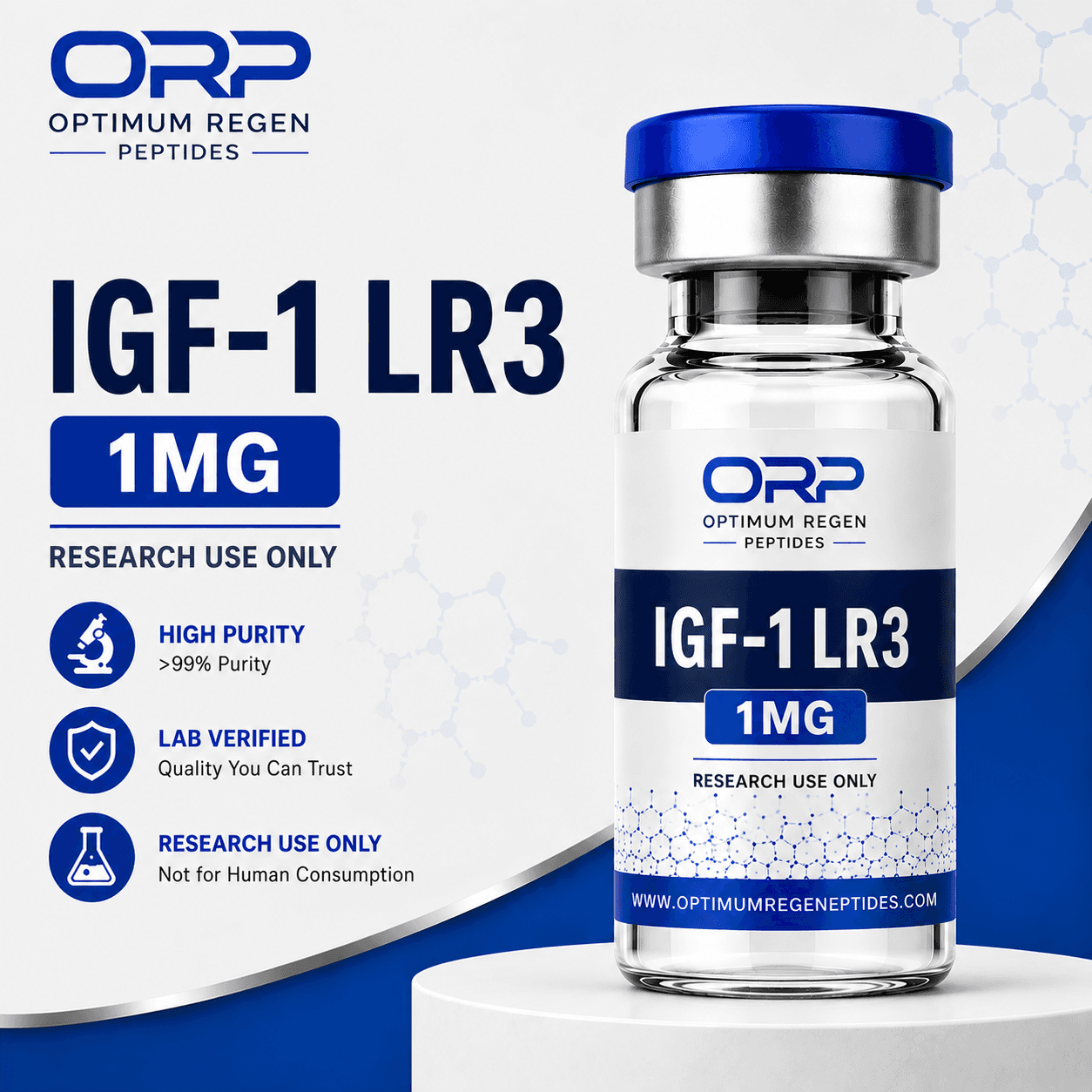
IGF-1 LR3
Compounded in a licensed US 503A pharmacy 🇺🇸
Growth Factor Research Peptide.
IGF-1 LR3 (Long R3 Insulin-Like Growth Factor-1) is a recombinant analogue of human IGF-1 engineered with an N-terminal 13-amino-acid extension and an Arg3 substitution to reduce IGF-binding protein affinity and extend biological half-life. Laboratory researchers evaluate it in growth factor receptor binding studies, cell proliferation assays, and anabolic signaling pathway investigations involving PI3K/Akt and MAPK cascades in vitro. It is widely used as a tool compound in muscle satellite cell and myoblast research to study differentiation and protein synthesis signaling in controlled laboratory settings. Supplied as a lyophilized recombinant peptide of analytical purity for in vitro and preclinical research use only.
- 1mg precision dose
- Research-grade purity
- Secure packaging
Independently tested by Freedom Diagnostics using HPLC and mass spectrometry. The figure above is this batch's own measured result, not a target.
IGF-LR3 · 1mg · Black Cap · reported 03/27/2026
- 2-day shipping nationwide, flat $13
- Plain, discreet packaging. No product names on the outside.
- Tracking emailed the moment your order ships.
About IGF-1 LR3
IGF-1 LR3 (Insulin-like Growth Factor 1, Long Arg3) is a synthetic analog of human IGF-1 in which the glutamic acid at position 3 is replaced by arginine and a 13-amino acid extension is added to the N-terminus. These structural modifications markedly reduce binding to IGF-binding proteins (IGFBPs), resulting in a molecule with extended biological half-life relative to native IGF-1 in preclinical model systems. This property makes IGF-1 LR3 a valuable tool compound for research into IGF-1 receptor (IGF-1R) signaling.
In laboratory settings, IGF-1 LR3 is used to study downstream signaling networks including the PI3K/AKT/mTOR and MAPK/ERK pathways. Researchers apply the compound to cell culture systems to examine effects on cell proliferation, glucose uptake, protein synthesis signaling markers, and differentiation endpoints in muscle, adipose, and neural cell models.
IGF-1 LR3 is supplied as a lyophilized research peptide and is intended solely for laboratory research use by qualified scientists. The extended half-life relative to native IGF-1 makes it useful in experimental designs requiring sustained receptor engagement, allowing researchers to study downstream signaling cascades without repeated compound additions.
Buy IGF-1 LR3 online
IGF-1 LR3 (Long R3 IGF-1) is in stock and available to buy online from Optimum ReGen Peptides — a real American research-peptide company with a physical storefront in Medford, Oregon, not an anonymous overseas dropshipper. Priced from $80, every order ships within two business days, flat $13 nationwide, in plain discreet packaging with tracking.
As your IGF-1 LR3 supplier we back every batch with a third-party certificate of analysis and compound in a licensed US 503A pharmacy. Vials are supplied lyophilized at analytical purity for laboratory and research use only, not for human consumption.
Researched For
IGF-1 LR3 is widely used in cell biology research to activate and study IGF-1 receptor-mediated pathways including PI3K-AKT-mTOR and Ras-ERK cascades without the confounding effect of IGFBP sequestration.
Myoblast and myotube models are frequently treated with IGF-1 LR3 to study protein synthesis signaling via mTORC1, satellite cell activation markers, and hypertrophic gene expression patterns in vitro.
Researchers have used IGF-1 LR3 in adipocyte and hepatocyte models to examine receptor-mediated glucose transporter translocation, Akt phosphorylation, and cross-talk with the insulin receptor signaling network.
IGF-1R is highly expressed in neural tissue; laboratory studies employ IGF-1 LR3 to investigate neuronal survival, axonal growth endpoints, and differentiation of neural stem cell populations in culture systems.
Because IGF-1R is overexpressed in multiple tumor lines, IGF-1 LR3 is used as a positive-control stimulant in studies characterizing anti-proliferative agents and receptor inhibitor compounds in oncology research assays.
How It Is Studied
IGF-1 LR3 is most commonly applied in cell culture at low nanomolar concentrations (typically 1 to 100 ng/mL range in published studies). Researchers measure phosphorylation of AKT at Ser473, S6K1 at Thr389, and 4EBP1 at Thr37/46 as proximal readouts of mTORC1 pathway activation. Western blot with phospho-specific antibodies is the standard detection method.
In animal model research, IGF-1 LR3 is administered subcutaneously or intraperitoneally. Its extended half-life relative to native IGF-1 means that less frequent dosing is required to maintain receptor engagement in in vivo designs. Researchers monitor body composition changes, organ mass indices, and tissue-specific gene expression profiles as study endpoints.
For IGFBP binding studies, researchers use competitive displacement assays comparing IGF-1 LR3 to native IGF-1 across a panel of binding proteins. This confirms the intended reduced-binding property of the analog and validates its utility as a tool for studying free IGF-1 receptor engagement without IGFBP-mediated buffering.
Specifications
| Form | Lyophilized powder |
|---|---|
| Purity | >= 99% (HPLC) |
| Molecular Formula | C400H625N111O115S9 |
| Molar Mass | ~9,117 Da |
| Chain length | 83 amino acids |
| Storage (lyophilized) | -20 °C, desiccated, light-protected |
Storage & Handling
Lyophilized IGF-1 LR3 should be stored at -20 °C in a desiccated, light-protected environment. The powder remains stable for extended periods under these conditions. For reconstitution, researchers use 0.1% acetic acid or sterile phosphate-buffered saline containing 0.1% BSA to prevent adsorption to vessel surfaces; the specific vehicle is determined by the experimental protocol.
Reconstituted solution should be stored at 4 °C and used within 24 to 48 hours when prepared without BSA carrier, or within 7 days when BSA is included as a stabilizer. Single-use aliquots prepared before reconstitution minimize protein degradation from repeated freeze-thaw cycles.
Frequently Asked Questions
How does IGF-1 LR3 differ from native IGF-1 in research applications?+
What concentration range is typically used in cell culture studies?+
Why is BSA sometimes added to the reconstitution buffer?+
Is IGF-1 LR3 the same compound as IGF-1 DES(1-3)?+
Is IGF-1 LR3 approved for any human use?+
Related research compounds