0105 areas
Growth Hormone Axis Research
CJC-1295 with DAC has been studied extensively as a GHRH analog to investigate the regulation of GH secretion and the pituitary's responsiveness to sustained receptor stimulation in preclinical models.

All research products on this site, including all peptides, are sold strictly for laboratory and research use only, not for human or animal consumption, diagnostic, or therapeutic use. Our tallow skincare products are topical cosmetics. You must be 21 or older to enter.
By entering you confirm you are 21+ and accept these products are for research use only. See our Terms and Disclaimer.
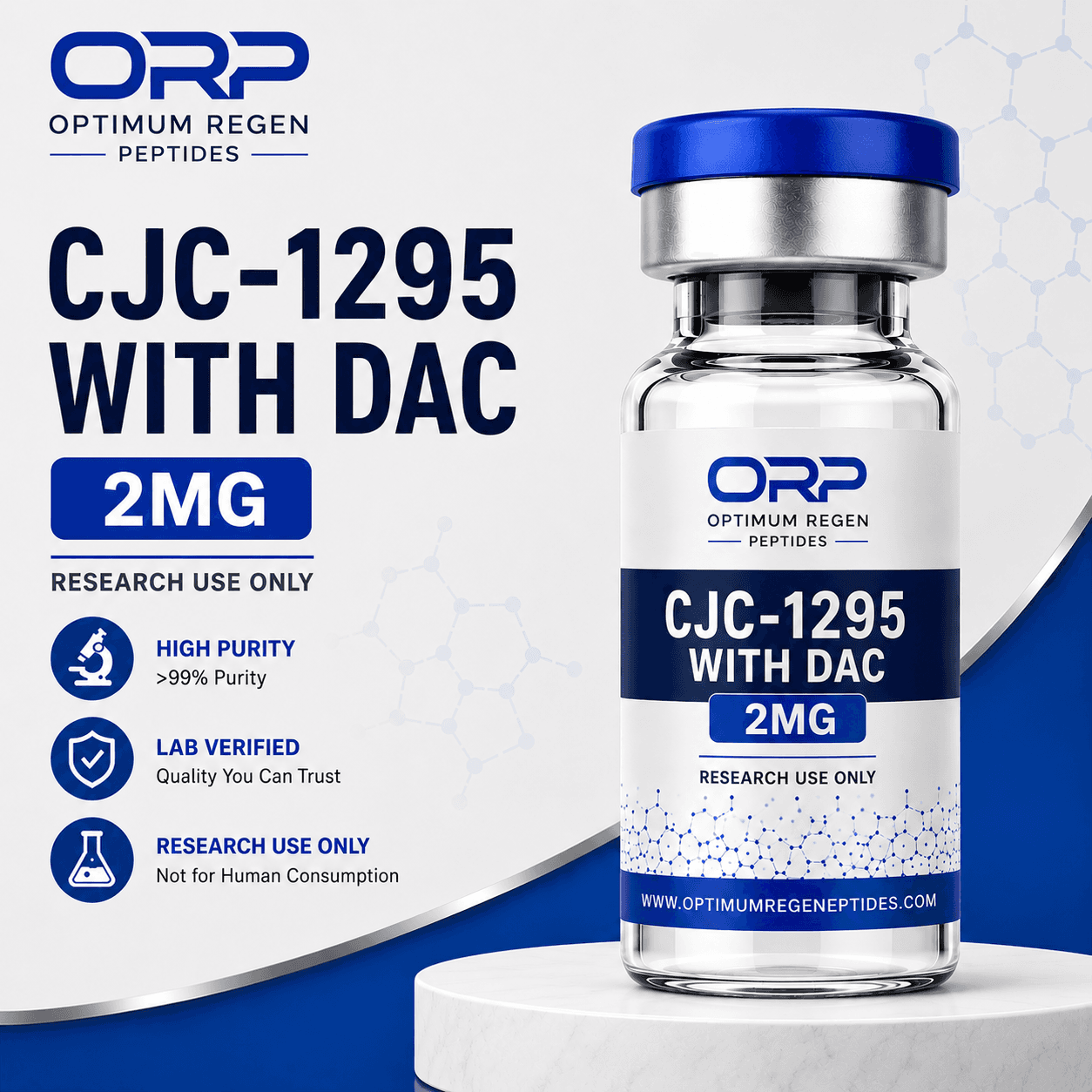
For laboratory research. Sold in 2mg and 20mg kit sizes.
Complete the order
Supplies and compounds researchers add to this order
Identity, purity and handling data for this compound, in one place. Tap an identifier to copy it.
For research use only. Not for human consumption.
CJC-1295 with DAC (Drug Affinity Complex) is a synthetic analog of growth hormone-releasing hormone (GHRH) that has been modified to extend its circulatory half-life. The DAC modification employs a maleimido-propionamide group that forms a covalent bond with serum albumin, dramatically prolonging the compound's residence time in biological systems compared to unmodified GHRH analogs.
In research models, CJC-1295 with DAC has been studied for its ability to stimulate growth hormone (GH) secretion from somatotroph cells of the anterior pituitary. The extended half-life allows investigators to examine sustained GHRH receptor activation and its downstream effects on GH and insulin-like growth factor 1 (IGF-1) levels over prolonged experimental windows.
Laboratory and preclinical studies have used this compound as a pharmacological tool to explore the GHRH axis, GH pulsatility, and the downstream anabolic and metabolic signaling cascades associated with chronic GH pathway stimulation.
The areas where this compound appears in the published research literature.
In laboratory research, CJC-1295 with DAC is commonly administered to rodent models at defined intervals, after which blood samples are collected and assayed for GH and IGF-1 concentrations via ELISA. The long half-life conferred by DAC allows researchers to study stable, sustained GHRH receptor engagement rather than acute pulses.
In vitro studies use primary pituitary cell cultures or somatotroph cell lines to examine receptor binding kinetics, cAMP signaling downstream of GHRH receptor activation, and GH secretion dynamics following CJC-1295 with DAC exposure.
Pharmacokinetic studies have characterized the albumin-binding behavior of the DAC modification using radiolabeled and fluorescently tagged versions of the compound, providing quantitative data on distribution, clearance, and effective half-life across species.
Lyophilized CJC-1295 with DAC should be stored at -20 °C in a sealed vial, protected from light and humidity. The lyophilized cake is stable under these conditions for extended periods. For working solutions, reconstitute in bacteriostatic water or sterile dilute acetic acid and store reconstituted aliquots at 4 °C for short-term use (typically up to 7 days) or at -80 °C for longer storage.
Repeated freeze-thaw cycles should be avoided as they can degrade peptide integrity. Aliquoting the reconstituted solution into single-experiment volumes prior to freezing is standard laboratory practice for preserving activity across multiple research sessions.
CJC-1295 (with DAC) for sale from Optimum ReGen Peptides, a US research-peptide company with a storefront in Medford, Oregon. It is in stock, priced from $60. Every order ships 2-Day Priority Air, a $13 flat rate anywhere in the US, with tracking, or can be picked up at the store.
The current batch has a published third-party certificate of analysis, shown above. CJC-1295 (with DAC) is supplied as lyophilized powder, for laboratory and research use only, not for human consumption.