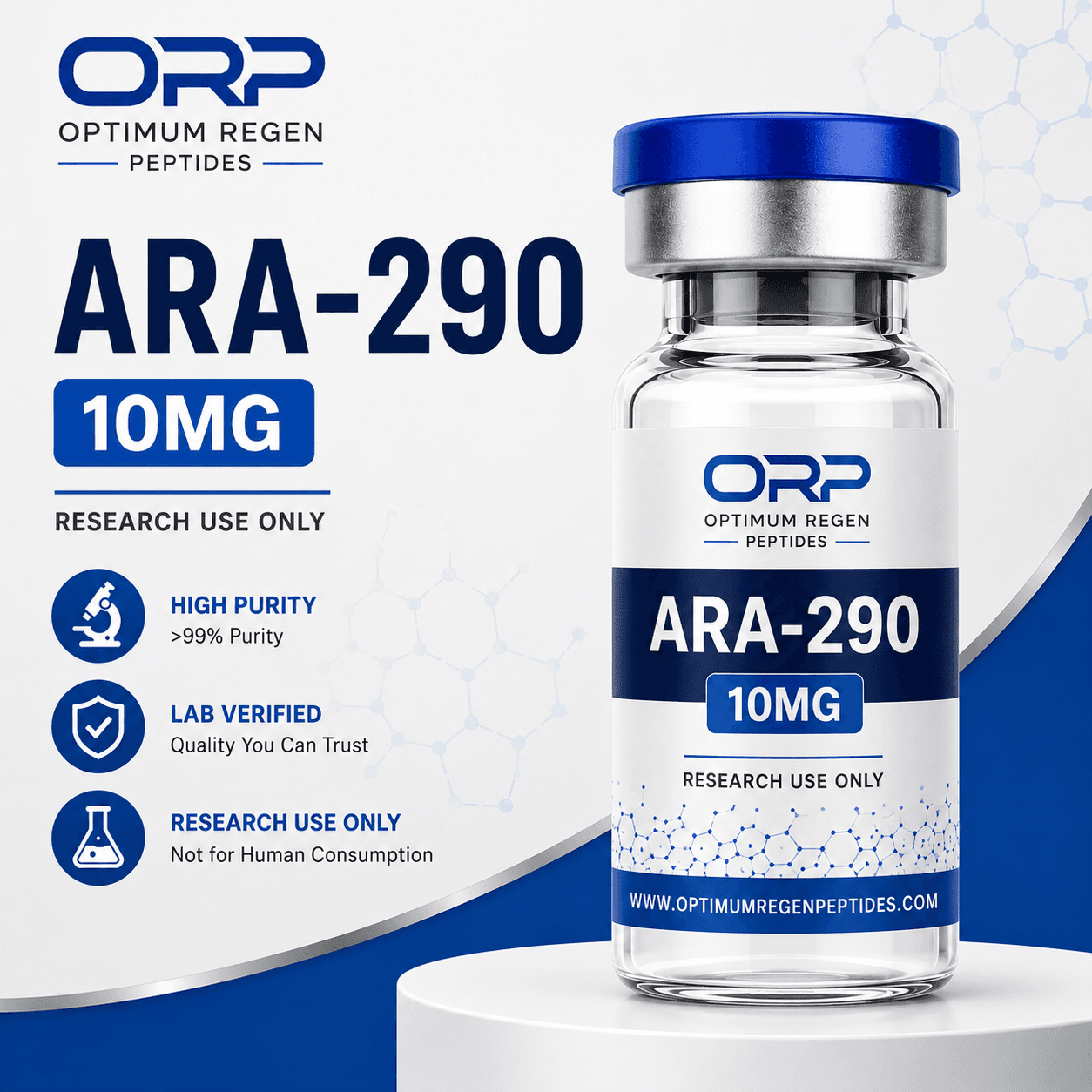
ARA-290
Compounded in a licensed US 503A pharmacy 🇺🇸
Tissue Support Research Peptide.
ARA-290 (also known as Cibinetide) is a synthetic peptide engineered from erythropoietin to selectively bind the innate repair receptor (IRR) without engaging the classical EPO receptor. Laboratory researchers investigate it in models of tissue stress, nerve signaling, and inflammatory pathway modulation. Preclinical studies have explored its interaction with small-fiber neural circuits and metabolic stress responses in controlled settings. Supplied as a lyophilized peptide of analytical purity for in vitro and preclinical research only. Store refrigerated and reconstitute under aseptic laboratory conditions.
- 10mg research vial
- Lyophilized for stability
- Research-grade compound
- Laboratory research only
Independently tested by Freedom Diagnostics using HPLC and mass spectrometry. The figure above is this batch's own measured result, not a target.
ARA-290 · 10mg · White Cap · reported 07/20/2026
- 2-day shipping nationwide, flat $13
- Plain, discreet packaging. No product names on the outside.
- Tracking emailed the moment your order ships.
About ARA-290
ARA-290 (also known as Cibinetide) is a synthetic peptide derived from the helical region of erythropoietin (EPO) that is specifically engineered to interact with the innate-repair receptor (IRR) rather than the classical EPO receptor. Researchers designed this compound to separate the tissue-protective properties of EPO from its hematopoietic activity, yielding a molecule studied primarily for its interactions with neural and metabolic pathways in laboratory models.
In preclinical research, ARA-290 has been investigated for its role in modulating inflammatory signaling cascades. Studies have explored how the compound engages the beta common receptor subunit in contexts such as peripheral nerve function and pancreatic beta-cell survival. Its selectivity profile makes it a subject of interest in laboratories examining how EPO-derived sequences interact with non-hematopoietic tissues.
As a lyophilized research peptide, ARA-290 is handled under controlled laboratory conditions. Researchers typically reconstitute it in sterile aqueous buffer for in vitro and preclinical in vivo model use. The compound is not intended for human or veterinary clinical use and is supplied exclusively for scientific investigation.
Buy ARA-290 online
ARA-290 (Cibinetide) is in stock and available to buy online from Optimum ReGen Peptides — a real American research-peptide company with a physical storefront in Medford, Oregon, not an anonymous overseas dropshipper. Priced from $60, every order ships within two business days, flat $13 nationwide, in plain discreet packaging with tracking.
As your ARA-290 supplier we back every batch with a third-party certificate of analysis and compound in a licensed US 503A pharmacy. Vials are supplied lyophilized at analytical purity for laboratory and research use only, not for human consumption.
Researched For
ARA-290 has been studied in rodent models of peripheral nerve injury, with researchers examining its interactions with small fiber neuropathy endpoints and nerve conduction parameters.
Laboratory investigations have explored whether ARA-290 engages protective signaling pathways in isolated beta cells and islet preparations under inflammatory challenge conditions.
Studies have characterized ARA-290's interactions with cytokine signaling networks, particularly its reported capacity to attenuate pro-inflammatory marker expression in cell-based assays.
Preclinical and early exploratory research has used ARA-290 to investigate innate-repair receptor engagement in models relevant to small-fiber damage associated with systemic inflammatory conditions.
Researchers have examined ARA-290 in high-fat-diet animal models, studying its effects on insulin sensitivity markers and adipose tissue inflammatory indicators at the cellular level.
How It Is Studied
ARA-290 is typically administered in preclinical models via subcutaneous or intraperitoneal routes at nanomolar to low micromolar concentrations. Researchers use ELISA-based cytokine profiling, immunohistochemistry of nerve tissue cross-sections, and electrophysiological measurements to characterize downstream effects following compound exposure in relevant animal models.
In cell-based assays, ARA-290 is applied to cultured neuronal cell lines, primary Schwann cells, and pancreatic islet preparations to study receptor binding kinetics and intracellular signaling responses including STAT3 and NF-kB pathway modulation. Confocal imaging and Western blot analysis are standard readouts used to quantify pathway engagement.
Researchers studying its selectivity profile use receptor binding competition assays comparing ARA-290 to full-length EPO, confirming that the peptide does not stimulate erythropoiesis at the concentrations used in tissue-protective studies. This mechanistic separation is a central focus of publications in the field.
Specifications
| Form | Lyophilized powder |
|---|---|
| Purity | >= 99% (HPLC) |
| Molecular Formula | C38H65N11O9 |
| Molar Mass | 820.0 g/mol |
| Storage (lyophilized) | -20 °C, protected from light |
| Storage (reconstituted) | 4 °C, use within 7 days |
Storage & Handling
Lyophilized ARA-290 should be stored at -20 °C in a desiccated environment away from direct light. The powder form is stable for extended periods under these conditions. Once reconstituted in sterile aqueous vehicle, the solution should be maintained at 4 °C and used within 5 to 7 days. Repeated freeze-thaw cycles following reconstitution should be avoided to preserve structural integrity.
For long-term laboratory inventory, individual aliquots should be prepared prior to reconstitution to minimize waste and degradation. All handling should be performed in a controlled laboratory environment by trained personnel using appropriate containment practices.
Frequently Asked Questions
What receptor does ARA-290 primarily target in research models?+
Does ARA-290 stimulate erythropoiesis in laboratory models?+
What solvents are used to reconstitute ARA-290 in research settings?+
How is ARA-290 purity verified for research-grade material?+
Is ARA-290 approved for clinical or veterinary use?+
Related research compounds