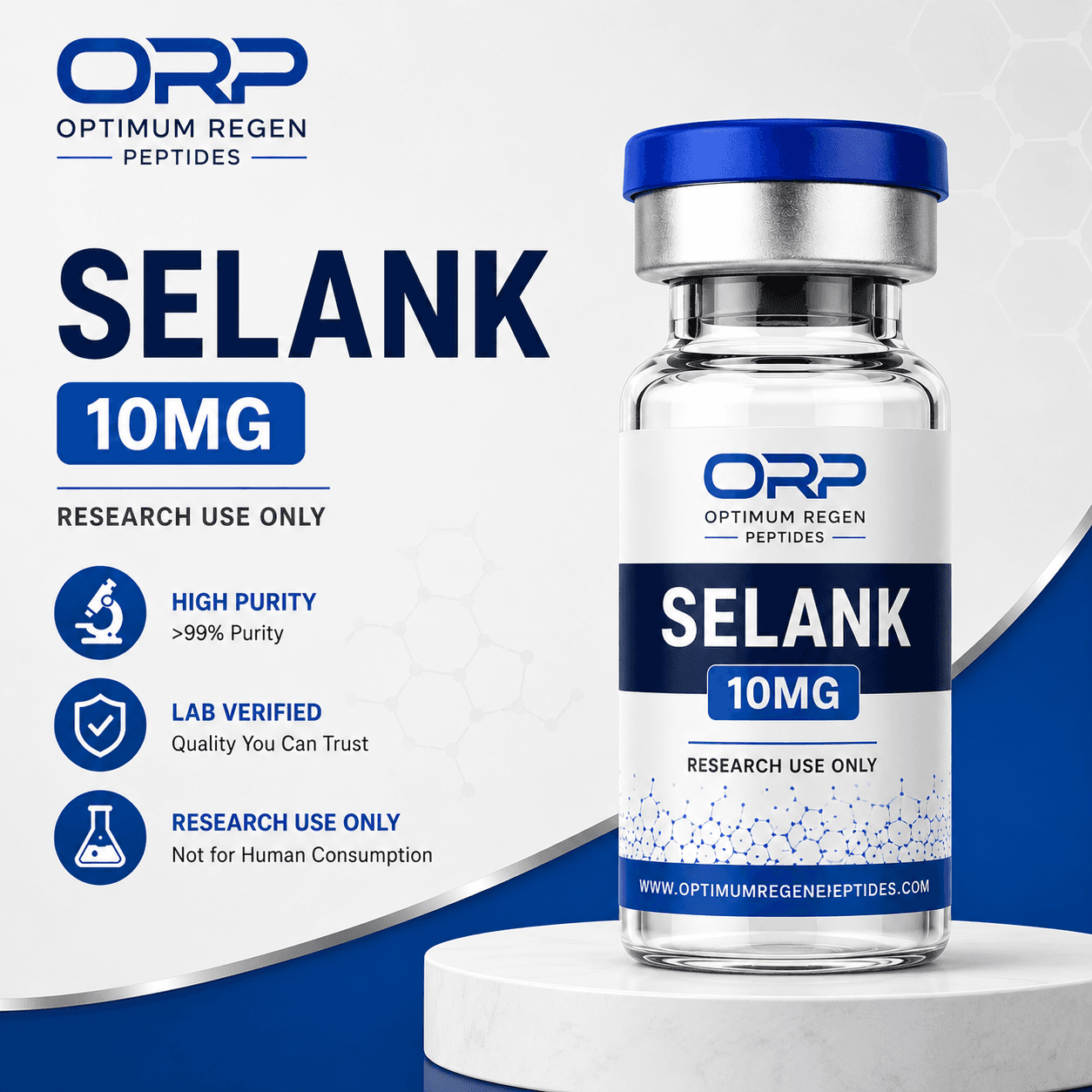
Semax
Compounded in a licensed US 503A pharmacy 🇺🇸
Nootropic Research Peptide.
Semax is a synthetic heptapeptide analogue (Met-Glu-His-Phe-Pro-Gly-Pro) derived from the N-terminal region of ACTH(4-10), studied in neurological and neuroprotective research models. Laboratory researchers investigate its effects on BDNF and NGF expression in neuronal cell cultures, as well as its interactions with dopaminergic and serotonergic signaling pathways in preclinical settings. It is employed in studies examining peptide stability, blood-brain barrier permeability models, and neuropeptide receptor pharmacology in controlled in vitro systems. Supplied as a lyophilized peptide of analytical purity for laboratory investigation only. Handle under sterile conditions and store refrigerated.
- 5mg vial
- Stable compound
- Research use only
Independently tested by Freedom Diagnostics using HPLC and mass spectrometry. The figure above is this batch's own measured result, not a target.
Semax · 10mg · White Cap · reported 07/06/2026
- 2-day shipping nationwide, flat $13
- Plain, discreet packaging. No product names on the outside.
- Tracking emailed the moment your order ships.
About Semax
Semax is a heptapeptide analog of the ACTH(4-7) fragment with the sequence Met-Glu-His-Phe-Pro-Gly-Pro. Developed in Russia at the Institute of Molecular Genetics of the Russian Academy of Sciences, Semax was designed to retain the cognitive and neuroprotective properties associated with ACTH-derived peptides while eliminating their steroidogenic activity. It has been studied extensively in neuroscience research contexts.
Laboratory investigations have characterized Semax's interactions with the brain-derived neurotrophic factor (BDNF) signaling pathway. In rodent model studies, Semax exposure has been associated with increased BDNF and TrkB mRNA expression in hippocampal and cortical tissue, placing it within the growing field of neurotrophic factor research. Researchers have also examined its reported modulation of dopaminergic and serotonergic markers in preclinical neural models.
Semax is available for laboratory research as a lyophilized powder. Researchers who use intranasal delivery models find Semax of particular interest due to its small size and the research literature documenting its CNS-relevant pharmacokinetic properties in preclinical studies. All use is confined to laboratory research settings by trained scientific personnel.
Buy Semax online
Semax is in stock and available to buy online from Optimum ReGen Peptides — a real American research-peptide company with a physical storefront in Medford, Oregon, not an anonymous overseas dropshipper. Priced from $60, every order ships within two business days, flat $13 nationwide, in plain discreet packaging with tracking.
As your Semax supplier we back every batch with a third-party certificate of analysis and compound in a licensed US 503A pharmacy. Vials are supplied lyophilized at analytical purity for laboratory and research use only, not for human consumption.
Researched For
Semax has been studied for its reported capacity to upregulate BDNF and NGF mRNA expression in rodent brain regions including hippocampus and cortex, making it a tool compound for researchers investigating neurotrophin signaling.
Preclinical research has examined Semax in rodent stroke and ischemia-reperfusion models, characterizing infarct volume, neurological deficit scoring, and inflammatory marker profiles in treated versus control cohorts.
Rodent behavioral research using Morris water maze, radial arm maze, and passive avoidance paradigms has been employed to study spatial learning and memory endpoints in Semax-treated cohorts.
Researchers have examined Semax interactions with monoaminergic neurotransmitter systems in rodent brain tissue, using HPLC-ECD measurement of regional dopamine, serotonin, and metabolite concentrations in treated animals.
Laboratory studies have explored Semax in models of optic nerve transection and retinal ischemia, examining retinal ganglion cell survival and BDNF pathway activation as endpoints.
How It Is Studied
Semax is administered to rodent models via intranasal instillation, intraperitoneal injection, or subcutaneous routes depending on the research design. Intranasal delivery models are of particular research interest given the compound's small molecular size and the desire to model CNS-targeted delivery approaches. Post-administration brain tissue is collected for BDNF ELISA, RT-PCR, and immunohistochemical analysis.
In vitro, Semax is applied to primary cortical neuron cultures and neural stem cell preparations. Researchers measure neuronal survival following oxidative stress or excitotoxic challenge using MTT/resazurin viability assays, caspase activation profiling, and mitochondrial membrane potential indicators. TrkB pathway phosphorylation status is assessed by Western blot.
Rodent behavioral studies complement biochemical endpoints. Researchers use standardized paradigms to quantify performance across treatment groups, and statistical analysis includes ANOVA with post-hoc correction. Semax's effect duration in behavioral models is a specific focus of pharmacodynamic research investigating the relationship between peripheral administration timing and CNS endpoint windows.
Specifications
| Form | Lyophilized powder |
|---|---|
| Purity | >= 99% (HPLC) |
| Sequence | Met-Glu-His-Phe-Pro-Gly-Pro |
| Molecular Formula | C37H51N9O10S |
| Molar Mass | 813.9 g/mol |
| CAS Number | 80714-61-0 |
Storage & Handling
Lyophilized Semax powder should be stored at -20 °C in a sealed, desiccated container away from light and moisture. Under these conditions it maintains stability for the labeled shelf-life period. Once reconstituted in sterile saline or phosphate-buffered saline, the solution should be kept at 4 °C and used within 5 to 7 days.
For research workflows requiring multiple time-points, pre-aliquoting prior to reconstitution minimizes degradation risk. Researchers should document reconstitution concentration, vehicle, and date. Discard any solution that becomes cloudy or develops particulate matter.
Frequently Asked Questions
What is the structural basis of Semax as an ACTH analog?+
How does Semax relate to BDNF research?+
Does Semax affect the hypothalamic-pituitary-adrenal axis?+
What animal models are most commonly used for Semax research?+
Is Semax approved for any regulatory use?+
Related research compounds