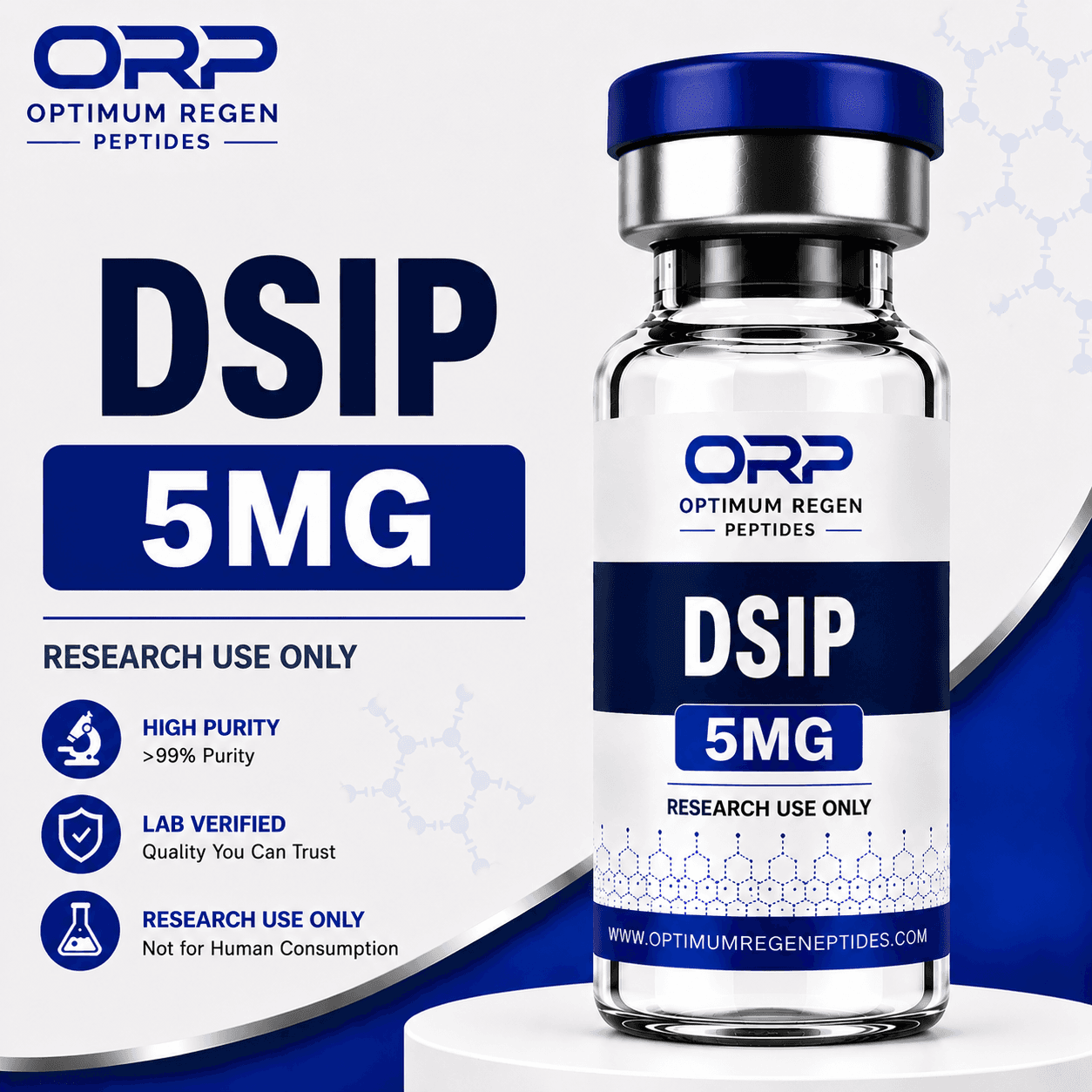
DSIP
Compounded in a licensed US 503A pharmacy 🇺🇸
Sleep Research Peptide.
DSIP (Delta Sleep-Inducing Peptide) is a nonapeptide first isolated from rabbit cerebral venous blood, studied in neuroregulatory and sleep architecture research models since the 1970s. Laboratory investigations have explored its interactions with hypothalamic and limbic receptor systems, as well as its potential modulatory effects on stress hormone pathways in preclinical settings. It is also researched in the context of circadian rhythm signaling and peptidergic neurotransmission in cellular and animal study models. Supplied as a stable lyophilized peptide for controlled laboratory investigation only. Reconstitute with sterile water and handle under appropriate biosafety conditions.
- 5mg research vial
- Stable lyophilized compound
- Research-grade formulation
- Laboratory research only
Independently tested by Freedom Diagnostics using HPLC and mass spectrometry. We have not published a certificate for this product yet, so no purity figure is shown here. Every vial carries an accession number you can look up directly with the lab.
- 2-day shipping nationwide, flat $13
- Plain, discreet packaging. No product names on the outside.
- Tracking emailed the moment your order ships.
About DSIP
DSIP, or delta sleep-inducing peptide, is a nonapeptide research compound with the published sequence Trp-Ala-Gly-Gly-Asp-Ala-Ser-Gly-Glu (CAS 62568-57-4, molecular formula C35H48N10O15). It is supplied to laboratories as a lyophilized powder for in vitro and preclinical research use only, not for human consumption, and is not intended to diagnose, treat, cure, or prevent any disease. Because DSIP is small, water-soluble, and structurally well characterized, it functions in many studies as a reference peptide for examining neuropeptide behavior in blood and cerebrospinal fluid research models.
The name delta sleep-inducing peptide reflects the peptide's original 1974 characterization by Monnier and colleagues, whose electrical-stimulation studies in rabbits linked cerebral venous extracts to delta-wave, or slow-wave, EEG activity associated with deep non-REM sleep stages. Subsequent laboratory work has focused less on reproducing that original observation and more on mapping how DSIP interacts with the systems that regulate circadian and ultradian rhythm in animal research models. Researchers frequently note that the sleep-inducing portion of the name describes the historical research context of its discovery rather than a demonstrated effect in any species, including humans.
DSIP peptide research today is concentrated in a handful of recurring model systems: rodent EEG and sleep-stage recording, isolated hypothalamic-pituitary tissue and cell-culture assays, and plasma stability and protein-binding studies. Much of the published literature approaches DSIP less as a single-mechanism peptide and more as a signaling molecule with multiple, still-debated points of interaction across the neuroendocrine system. This breadth is part of why DSIP continues to appear in comparative-peptide panels alongside other short neuropeptides studied for hypothalamic and pituitary signaling.
Documented DSIP research applications include studies of opioid-tolerance and withdrawal models, stress-response and gastric stress-ulcer models in rodents, chronobiology and circadian-rhythm research, and early radioprotection studies examining peptide behavior under radiation exposure in animal tissue. Each of these lines of investigation uses DSIP as a tool compound to probe a specific physiological pathway rather than as a single-purpose research subject. Researchers comparing findings across these application areas typically note that DSIP's effects appear model-dependent, varying with concentration, tissue type, and experimental timing in ways that are still being mapped in the literature.
Proposed research mechanisms for DSIP include modulation of GABA-ergic signaling, interaction with hypothalamic-pituitary-adrenal (HPA) axis regulation, and a possible role in growth-hormone secretion pathways, alongside its previously noted capacity to cross the blood-brain barrier under certain experimental conditions. None of these mechanisms is fully established; the peptide research literature describes them as competing hypotheses rather than a settled mode of action. This mechanistic ambiguity is itself a reason DSIP remains an active subject of comparative neuropeptide research.
DSIP reconstitution for laboratory use typically involves adding bacteriostatic or sterile water slowly down the interior wall of the vial, then swirling gently rather than shaking, since agitation can shear the peptide's structure. Reconstituted DSIP is generally kept refrigerated at 2-8°C and used within the timeframe defined by the receiving lab's protocol, with repeat freeze-thaw cycles avoided because they degrade peptide integrity over time. This reconstitution guidance describes laboratory handling procedure only; it is not administration or dosing guidance for humans or animals.
Researchers who buy DSIP peptide for laboratory use typically prioritize three things: a documented amino acid sequence and purity threshold, a third-party certificate of analysis confirming identity by mass spectrometry or HPLC, and consistent batch-to-batch sourcing from a compounding pharmacy rather than an unregulated bulk supplier. Optimum ReGen Peptides compounds DSIP through a licensed US pharmacy and provides third-party test data with each batch so that peptide identity and purity are documented before it reaches a research setting. This traceability matters for research validity, since impurities or degraded peptide can confound comparative-peptide findings well before a study reaches analysis.
Buy DSIP online
DSIP (Delta Sleep-Inducing Peptide) is in stock and available to buy online from Optimum ReGen Peptides — a real American research-peptide company with a physical storefront in Medford, Oregon, not an anonymous overseas dropshipper. Priced from $35, every order ships within two business days, flat $13 nationwide, in plain discreet packaging with tracking.
As your DSIP supplier we back every batch with a third-party certificate of analysis and compound in a licensed US 503A pharmacy. Vials are supplied lyophilized at analytical purity for laboratory and research use only, not for human consumption.
Researched For
DSIP was originally characterized by its ability to induce delta wave activity in EEG recordings in rabbit models. Laboratory studies have continued to investigate its role in sleep-wake cycle regulation and its interactions with endogenous sleep-promoting systems.
Research has examined DSIP's interactions with corticotropin-releasing hormone (CRH) and ACTH pathways, with investigators studying how the peptide influences stress hormone cascades in both in vitro and animal model systems.
Studies have investigated DSIP's effects on gonadotropin release, growth hormone secretion, and other pituitary hormone dynamics in research models, positioning it as a compound of interest in neuroendocrine axis research.
More recent laboratory investigations have examined DSIP for potential antioxidant properties and cytoprotective effects in cell culture models, exploring whether the peptide influences oxidative stress markers at the cellular level.
Some preclinical studies have explored DSIP in pain pathway models, investigating its interaction with opioid receptor systems and examining behavioral pain measures in animal subjects under controlled research conditions.
How It Is Studied
Classical DSIP research employs EEG telemetry in freely moving rodents or rabbits, with continuous electrophysiological recording used to quantify changes in sleep architecture following peptide administration. Power spectral analysis of EEG frequency bands allows researchers to objectively characterize delta, theta, and spindle activity in treated versus control animals.
HPA axis studies measure serum cortisol, ACTH, and CRH levels via radioimmunoassay or ELISA following DSIP administration in stress-challenged animal models. Researchers examine dose-response relationships and time-course effects to characterize how the peptide interacts with the stress hormone cascade under controlled laboratory conditions.
Neuroendocrine experiments use pituitary cell cultures (GH3, AtT-20) and primary pituitary tissue explants to measure peptide release in response to DSIP. Mass spectrometry-based peptide profiling and protein expression panels help researchers map DSIP's interactions with hormone-secreting cell populations at the molecular level.
Specifications
| Form | Lyophilized powder |
|---|---|
| Purity | >= 99% (HPLC) |
| Molecular Formula | C35H48N10O15 |
| Molar Mass | 848.8 g/mol |
| CAS Number | 62568-57-4 |
| Sequence | Trp-Ala-Gly-Gly-Asp-Ala-Ser-Gly-Glu |
Storage & Handling
Lyophilized DSIP should be stored at -20°C in a desiccated, light-protected environment. Under proper cold storage, the peptide remains stable over extended research timelines. Vials should be equilibrated to room temperature under desiccant before opening to prevent moisture condensation.
Reconstituted DSIP solutions for laboratory use should be held at 4°C and consumed within 24 to 48 hours. Researchers are advised to prepare small working aliquots to avoid repeated temperature cycling, which can accelerate degradation of the peptide structure.
Frequently Asked Questions
What is DSIP peptide?+
What is delta sleep-inducing peptide?+
What is DSIP peptide research?+
How do you reconstitute DSIP peptide?+
Where can you buy DSIP peptide for research?+
What are DSIP research applications?+
What is the amino acid sequence of DSIP?+
What is the CAS number for DSIP peptide?+
Is DSIP peptide third-party tested?+
How should DSIP peptide be stored?+
Related research compounds